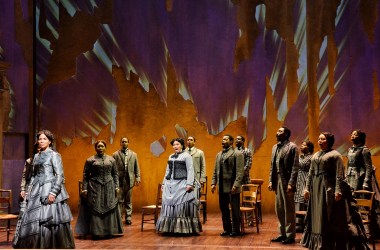
Think back to the first time you saw West Side Story. Didn’t you feel for Tony and Maria, the racially mixed couple whose poignant love story ends in tragedy? If your answer is “no,” chances are you are a man. Let us stipulate immediately that this does not prove men are unfeeling pigs. Rather, the impulse to sympathize with a fictional character seems to be triggered in different ways for males and females. At least, that’s the conclusion of a new study by psychologists Thalia Goldstein and Ellen Winner, which tracked reactions to Leonard Bernstein’s musical theater ... Read More
Actors: Emotionally Aware, Yet Particularly Vulnerable
What sort of person is driven to become an actor? It’s a career that demands extraordinary emotional openness, but inevitably involves a steady stream of rejections—interspersed, for the lucky few, with the occasional short-lived success. Does this instability make actors more vulnerable to emotional problems, as so many high-profile Hollywood breakdowns would suggest? Or does the process of portraying other people—which often involves reliving tragic events onstage, night after night—help thespians come to terms with their own traumas? Paula Thomson and S. Victoria Jaque of ... Read More
Musicals Have the Power to Change Minds
Broadway musicals are often thought of as lightweight entertainment. In fact, from South Pacific to The Book of Mormon, many of the greatest shows incorporate serious themes and challenge audience members’ assumptions. But can minds really be opened through story and song? Newly published research provides evidence that will warm the hearts of cockeyed optimists. “Musical theater may be a promising method for promoting attitudinal change,” write Frederick Heide, Natalie Porter and Paul Saito of Alliant International University in San Francisco. Their study, published in the journal ... Read More
Deploying to a Different Kind of Theater
Derek Blumke stumbled upon an odd souvenir in an Afghan bazaar when he was serving in the country with the Air Force during the first years of the U.S. war there. “It’s a British 1842 bayonet, and I’m buying it from a local in Afghanistan,” he recalled. “Why wouldn’t you buy that?” On novelty alone, the find was priceless. Blumke had no sense at the time, though, of its context — what the thing was even doing there. He went into Afghanistan, like most soldiers in America’s nine-year conflict, with little sense of the local culture and language, let alone its ... Read More