

Pacific Standard July-August 2013 Cover

Why Do We Still Have Summer Vacation?

summer-vacation

Next week begins, in many cases, the three-month period that is summer vacation from school. For those of us long outside of education, and without children of our own, it may be a little hard to recall the sheer joy that is summer vacation. Three whole months outside of the classroom. Your mother surely got annoyed with your sunburns, the fact that you preferred to spend the day playing video games, and your demands to be taken over to your friends’ houses to play, but at least for a few days after school let out in June, did anything on Earth seem better? But if for children those three ... Read More

Why Do Music Students Have Higher SAT Scores?

music

The figures look so good, it’s no wonder that they’re trumpeted by the National Association for Music Education. “On the 2012 SAT,” the organization notes, “students who participated in music scored an average of 31 points above average in reading, 23 points above average in math, and 31 points above average in writing.” A strong argument in favor of music education? Maybe not so much. As we point out regularly here, correlation and causation are very different things. Newly published research concludes those differences reflect the types of kids who decide to participate in ... Read More

Stephen Joel Trachtenberg Pokes at the Foundations of the Ivory Tower

george-washington-university

Stephen Joel Trachtenberg, president emeritus of Washington, D.C.’s The George Washington University, has spent most of his life thinking about higher education, either as a student—he has an undergraduate degree from Columbia, a law degree from Yale, and a master’s in public administration from Harvard—or as an administrator. He retired in 2007 as president of George Washington after 19 years on the job, and has written The Art of Hiring In America’s Colleges & Universities, Thinking Out Loud, and Reflections on Higher Education. Would you reprise what you said about ... Read More

Chicago Teachers’ Strike: What Do We Want? Better Management Gurus Might Help

Chicago Teachers Union Strike

The Chicago teachers’ strike, which is now entering its second week, represents more than a simple dispute about pay and benefits, as many observers have noted. It’s more like a gauntlet thrown down against the entire education reform agenda—the broad centrist policy movement that seeks to bring merit pay, metrics, pink slips for underperformance, and other business school concepts to the American schoolhouse. Indeed, one of the main sticking points in the dispute is Chicago Mayor Rahm Emanuel’s desire to tie a substantial part of teachers’ professional evaluations—as much as 40 ... Read More

To Boost Creativity, Study Abroad

Creativity Boost Abroad

Looking to hire someone who will make a creative contribution to your organization? Here’s a tip: When checking applicants’ college transcripts, don’t focus exclusively on their grades or honors. Take note of whether they spent time studying abroad. That’s the implication of newly published research, which provides the best evidence yet that studying overseas boosts one’s creativity. A semester spent in Spain or Senegal leads to higher creativity scores on two different tests, according to research conducted by Christine Lee, David Therriault, and Tracy Linderholm of the ... Read More

College: What It Was, Is, and Should Be

College: What It Was, Is, and Should Be

Edward Gibbon’s The Decline and Fall of the Roman Empire is often loosely cited to support even looser claims that America is declining. But Gibbon’s observation that in ancient Rome “a cloud of critics, compilers, of commentators, darkened the face of learning” does resonate with something that's gone wrong in American liberal-arts education. In his telling, Rome’s loss of its republican virtues had left its later writers and orators in “very unequal competition with those bold ancients” who had expressed “their genuine feelings in their native tongue” and, "living under a ... Read More

Can We Make College Cheaper?

Number of Years with a Percentage Price Increase Exceeding the Inflation Rate

Critics of American higher education have a set of theories to explain the ever-rising cost of college tuition. Schools are inefficient. They blow too much money on administrators, not enough on academics. The academics they do have spend their time on research, not students. And those students live in an increasingly plush world created by the arms race for prestige rankings: Best medium-sized college in the Midwest! Most wired campus in the country! Top-rated college for would-be aerospace engineers! “These people are going to say, ‘Ah! Colleges, they’ve turned themselves into ... Read More

Arts Involvement Narrows Student Achievement Gap

Students from the lower end of the socioeconomic ladder tend to do less well in school than those from more upscale families. But newly published research identifies one sub-group of these youngsters who tend to exceed expectations: those who participate heavily in the arts. “At-risk teenagers or young adults with a history of intensive arts experiences show achievement levels closer to, and in some cases exceeding, the levels shown by the general population studied,” a team of scholars writes in a new National Endowment for the Arts Research Report. “These findings suggest that ... Read More

Learning to Read When a School System Falters

Dolan and Moustafa

On a hot, sunny September afternoon — the sticky kind so common in New York City that time of year — a tall, dark-haired young man with his shoulders hunched slightly forward padded into Franklin Delano Roosevelt High School’s back entrance and into a small courtyard. Moustafa Elhanafi sought the school’s principal. He needed her help. Not being a student there, he didn’t know what she looked like or where he would find her inside the massive, unfamiliar building. In the courtyard beneath the shade of a wide-leafed tree, looking for crafty students cutting class, stood Principal ... Read More

No Debate: Kids Can Learn By Arguing

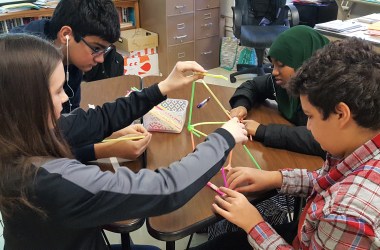
Let’s not “agree to disagree,” says Deanna Kuhn. The Columbia University professor of psychology and education wants to bring back serious debate in America — in sixth grade, if not sooner. Kuhn is tired of hearing that people have a right to their own opinion. It’s too easy to fall into thinking that all opinions are equal, she says, and “so why bother?” The country needs citizens who can make logical arguments “based on substantive claims, sound reasoning, and relevant evidence,” she writes. That’s language from the new educational standards for middle school, adopted ... Read More