Pacific Standard July-August 2013 Cover

Solar Success Stories in the Wreckage of Sandy

A passive solar house in East Amwell, New Jersey.

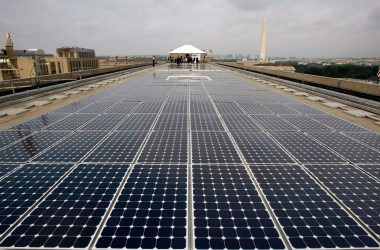
Hurricane Sandy knocked out most of the power along coastal New Jersey and New York, some of it still off, but  photovoltaic cells and passive solar construction have created some bright spots. For example, the storm and its subsequent flooding had little effect on one school located roughly 600 feet from Newark Bay on a peninsula directly in harm’s way. While surging seawater wreaked corrosive havoc on the underground power lines that feed into Bayonne, New Jersey’s Midtown Community School, the campus has, and had, uninterrupted electrical service thanks to the prescience of ... Read More

Cleaning Clean Energy: Robots to Keep Solar Panels Spotless

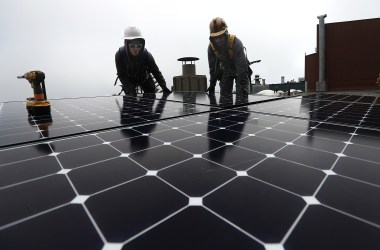
To soak up the sun as efficiently as possible, solar panels need to be kept near spotless. But with some solar fields covering as many as 3,000 acres it would take a lot of squeegees to clean all those photovoltaic panels. Which is why three students from Cal Tech and UCLA created a solar-panel cleaning robot. Two operators place the robot at the start of a line of solar panels. The robot—which looks sort of like a refrigerator door—glides along, cleaning with soft rotating brushes and squeegees as it travels down the line of panels. The robot feeds information via a computer to an ... Read More

Navajo Nation Builds Momentum for Renewable Energy

There’s a Navajo saying: “When you walk into the future, you must walk in beauty.” When it comes to energy, this is difficult to follow for the current generation of Navajo. Many of the dirtiest coal plants and uranium mines in the country are on Navajo Nation, polluting its land and water and causing health problems. Despite this, of the 300,000 enrolled Navajo tribal members, it is estimated that 18,000 of them don’t have electricity. This past summer, Dreaming New Mexico and New Energy Economy, two energy-focused organizations at work in the Southwest, installed solar panels ... Read More

Consistency Key to Renewable Energy Policy

The bankruptcy of the solar startup Solyndra last month has placed government funding for renewable energy projects under a microscope. Were the government-guaranteed loans a wise way to use public funding to help green technologies? An analysis conducted by the George Soros-funded Climate Policy Initiative (“Evaluating Policies for Low Carbon Growth”) looked at six large-scale renewable energy projects in the United States and Europe, seeking answers about how their real costs matched up with their estimates, and "how policy affects project economics." The six projects were: wind ... Read More

Solyndra’s Problems Were More Politics Than Power

In September, Dan Arvizu, who heads the U.S. National Renewable Energy Laboratory, made a prescient prediction during a European solar energy conference. He said the meteoric growth of photovoltaic installations over the last six years would cause fossil fuel and nuclear interests to demonize solar cells in hope of killing what they might see as a powerful threat. Days later, Washington politicians started ramping up an investigation into Solyndra, a leading maker of thin-film solar cells that had gone bankrupt two years after receiving a $535 million loan guarantee from the U.S. ... Read More

Greece, North Africa Promote Their Solar Projects

If you listen to solar advocates in Europe, the upheavals on this side of the globe — revolutions in North Africa, debt misery in Greece — have only brightened the prospects for solar power. German plans to phase out nuclear power have put at least one large nation in the market for new sources of power, and two would-be providers have sworn that global crises won't hurt their ambitions. On the contrary — they'll help! (Just watch out for those other solar salesmen.) First there's Greece. Germany's perennial project to both aid Greece and save the euro might include a deal to buy ... Read More

Solar Entrepreneurs’ New Sales Pitch

Solar power has taken root — not in the U.S. where it supplies but 1 percent of the power generated only from renewable sources — but in energy-deprived villages of the developing world. Because costs for electricity in the U.S. are already low, unlike in rural India and Africa, the incentive to turn over to solar is lower for American households. But in poor areas around the world, some communities have skipped an entire generation of coal-powered electricity. Despite the attractiveness of solar cells and solar concentrators lighting up and heating poor villages, solar brings its ... Read More

Confessions of a Nuclear Power Safety Expert

When Italy decided in the mid-'70s to add nuclear power to its power portfolio, young mechanical and nuclear engineer Cesare Silvi was among those attracted to the opportunities it presented. His work centered on nuclear safety issues — in particular, what might happen if something unexpected struck a power plant. Corners he saw cut there eventually soured Silvi on that endeavor. His next position — at the Italian Commission on Nuclear and Alternative Energy Sources, which included work on nuclear disarmament — eventually soured him on nuclear energy itself. "[If we] continue with ... Read More

Rooftop Solar Power to the People?

Are New Solar Power Projects Anti-Environmental?

While chasing the mirage of a game-changing renewable energy source in the form of industrial-scale solar plants capable of powering hundreds of thousands of homes, the federal government has turned its back on a better, cheaper form of energy from the sun: distributed solar power generation, sometimes known as rooftop solar. At least, that's the way desert environmental advocates see it. A coalition of scientists and local land conservationists calling itself Solar Done Right envisions roofing homes, commercial buildings and parking lots throughout the Southwest with a vast network of ... Read More

Solar Showdown: Are New Solar Power Projects Anti-Environmental?

May-June 2011

Last December, I flew to Phoenix, rented a car and drove two hours west on Interstate 10 to Blythe, Calif., a sun-baked town of 13,000 on the lower Colorado River surrounded by orange groves and irrigated farmland. In the winter, this area attracts tens of thousands of snowbirds, many of whom park their recreational trailers along dirt roads in the desert and tool around in all-terrain vehicles. I hadn't come to see them, though. I wanted to learn about another new arrival, an international consortium called Solar Millennium LLC, which is building a 7,000-acre solar power generating station ... Read More