Pacific Standard May-June 2013 Cover

Our Planet’s Destiny Lies in Its Pastures

cattle-pasture

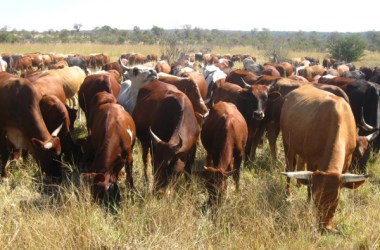
A couple of times in the past we’ve written about the work of biologist Allan Savory, a Zimbabwean wildlife ranger turned rancher whose land management of Southern Africa’s dry savannahs attempts to mimic the wild herds that the captive ones supplanted. As Judith D. Schwartz wrote for us in 2012: Savory developed a land management process, holistic management, that challenged the conventional belief that grazing can only harm land. The key, said Savory, was to manage livestock to mimic the behavior of wild herds, intensively grazing (and defecating on and trampling upon the ground) and ... Read More

Just Planting Trees Won’t Stop March of Deserts

USDA map of world desertification

Attendance was sparse at a press conference following last fall’s first ever U.N. General Assembly devoted to desertification, as the loss of fertile land in dry areas is known. “If this were about climate change, the room would be full,” Luc Gnacadja of Benin, executive secretary of the United Nations Convention to Combat Desertification, began his remarks to the press. On the 20th anniversary of the 1992 United Nations Conference on Environment and Development, where the desertification convention was established, it remains a poor cousin to other groundbreaking treaties set up at ... Read More

New Dirt on Climate Change

Bighorn Basin

For decades, geologists have been drilling — literally — for clues that would help them understand ancient wholesale changes in Earth’s climate, clues that could shed light on current global warming. Usually, their efforts have been aimed at sea sediments taken from cores extracted hundreds of feet beneath the ocean floor. But in a more terrestrial project this past summer, an international geological team led by the University of New Hampshire began deep-core drilling at three sites in Wyoming’s Bighorn Basin east of Yellowstone National Park. These six new core samples from ... Read More

Roving Herds of Grazing Climate Helpers

In reports of rising CO2 levels, there's an impression that the carbon-and-oxygen molecule is some kind of toxin, an alien vapor coughed up by a century-plus of heedless industrialism that's come back to haunt us. On closer inspection, it seems the problem isn't carbon dioxide's presence, but that there's too much in the air and not enough in the ground where it lends fertility to agricultural soil. How do we get that carbon back in the soil? Some suggest placing calcium carbonate or charcoal (aka "biochar") directly into agricultural soil, as Miller-McCune examined last year. But ... Read More

Celebrating Earth Day with ‘DIRT! The Movie’

We think that diamonds are very important, gold is very important, all these minerals are very important," says Wangari Maathai, the Kenyan Nobel Peace laureate who helped women in her country plant more than 40 million trees. "We call them precious minerals. ... But that part of these minerals that is on top, like it is the skin of the Earth, that is the most precious of the commons." Resplendent in a yellow dress and head wrap, Maathai is the moral center of DIRT! The Movie, a kaleidoscopic celebration of the saviors of the soil, from the plains of Africa to the sidewalks of The Bronx. ... Read More

The Story of P(ee)

"P" is for phosphorus, the stuff of life, and "p" is for "peak phosphorus" by 2030, ecologists say, unless — presto! — pee can be turned into gold through modern-day alchemy. Unremarked and unregulated by the United Nations and other high-level assemblies, the world's supply of phosphate rock, the dominant source of phosphorus for fertilizer, is being rapidly — and wastefully — drawn down. By most estimates, the best deposits will be gone in 50 to 100 years. Worse, phosphorus production could peak in just two decades, according to new research from Australia and Sweden. That's ... Read More

The Dirt on Climate Change

Conflicts tend to scatter people, and ideas, in unexpected ways. After the American Civil War, a flood of so-called Confederados fled the devastated South and set up farms in the Brazilian Amazon. They planted rice and sugar cane and tobacco, and they prospered. But the lands they settled — primarily high bluffs along rivers — weren't any more pristine than Alabama or the Carolinas had been. As they plowed, the settlers unearthed vast quantities of potsherds that showed the land had been inhabited before. And the ceramics weren't the only sign of previous human cultivation: The deep black ... Read More