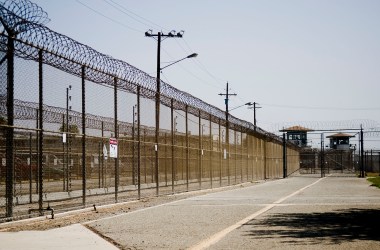
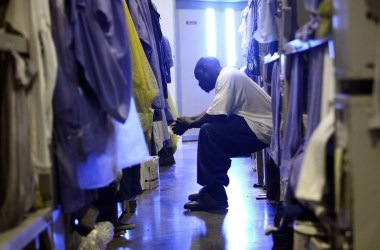
Anthony Montoya has spent the past 32 years — more than half his life — in prison for burglary and second-degree murder. Based on his crimes and long institutional existence, it’s no surprise that a Colorado parole board has denied Montoya 11 times, and a corrections board has shot down early release three times. Last August, as the morning sun streaked through the windows of an 11th-floor conference room, the Denver Community Corrections Board considered Montoya, who is 57, for supervised discharge into a new county work-release program. “Anthony Montoya,” the chair of the ... Read More
Lee Baca Wants to Educate L.A.’s Prisoners
Los Angeles County Sheriff Lee Baca wants to teach criminals a lesson — literally. The top cop of America's most populous county is launching a new initiative aimed at offering education to every one of the 160,000 inmates who pass through his lockups each year. Liberal reformers have long advocated such a course, citing studies showing lower recidivism rates among prisoners who learn while locked up. But it's extraordinary talk coming from the man who runs America's biggest jail system. Baca's Education-Based Incarceration initiative officially launched last year but is still in the ... Read More
Budget Idea: Divert Money From Prisons to Schools

Solving state and national budget woes is going to demand a painful set of decisions on where to carve out money — from public services, public safety, environmental protection? — no matter where legislators look. But an unlikely coalition of organizations, including the NAACP, ACLU and Grover Norquist's Americans for Tax Reform,* is rallying around a common target: Why, they ask, are we spending so much money on prisons? Over the last 40 years, America's inmate population has quadrupled, from 500,000 to 2.3 million, giving the U.S. 5 percent of the world's population, but 25 percent ... Read More
Convict Commodification
Like corn and computers, convicts have become commodities in America, produced en masse in concentrated locations. But America hasn't always produced bumper crops of inmates, sociologist Bruce Western explained last summer at the annual American Sociological Association convention, speaking with fellow Harvard sociologist Robert J. Sampson to highlight a special issue of Daedalus, the journal of the American Academy of Arts and Sciences. The issue presented the work of 15 scholars — and two poets — who examined America's culture of mass incarceration and its effects on neighborhoods that ... Read More
Why Victims Face the Criminals Who Hurt Them

Diana Owen knows the standard crime-victim revenge fantasy, the one in which you confront, even hurt or kill, the criminal who preyed on you. A sly grin crosses her face as the self-proclaimed "badass" jokes about what she would do to the man who molested her when she was 10: "Put me in an alley with him, you know what I mean?" The paranoia that tortured Owen for a dozen years after the crime was hardly a joke. From adolescence through her troubled teens and into young adulthood, the scenarios changed, but the anxiety and fear were constants. "I would think about what if he tried to kill me ... Read More
New York Takes Swing at Prison Gerrymandering
Earlier this summer, Miller-McCune highlighted a report from the NAACP Legal Defense Fund on the controversial practice of "prison-based gerrymandering." The census accounting trick — by which prisoners are tallied in the districts where they are incarcerated, not where they permanently reside — dilutes the voting power of minority communities, the Legal Defense Fund argued. The Census Bureau this year is trying for the first time to make it easier for states to adjust how they factor prison populations into redistricting. And now a third state intends to change the practice. The New ... Read More
Prisoners of the States
In March 2004, the Abu Ghraib scandal seared unsightly images of prisoner abuse into the consciousness of a new generation of Americans. The allegations blindsided citizens who — galvanized by the specter of a nuclear Saddam — had been mostly supportive of the pre-emptive invasion of Iraq. Not since the Mai Lai massacre in Vietnam 42 years earlier had so many questioned whether the nation held higher moral ground than its enemies. Despite the courts-martial of the guards involved, the ensuing media frenzy only muddled the policy debate regarding the status of "unlawful combatants." The ... Read More
Prison-Based Gerrymandering Dilutes Blacks’ Voting Power
Sixty-six percent of the inmates in the state of New York come from New York City. But 91 percent of them are incarcerated upstate, in communities where they have long been counted by the U.S. census. On paper, this means prisoners belong not to the communities from which they've come (and to which they eventually will return), but to places where they can neither vote, check out a library book or attend a local school. The counting quirk sounds like a quandary for demographers. But it also means, come gerrymandering time, that many urban black communities look smaller than they actually ... Read More