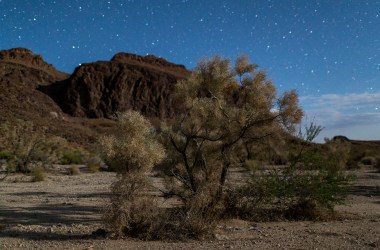
The desert sky was an odd brooding gray as we pulled into McDonald's, the arches looming bright and preternaturally yellow out of the dusty landscape. By the time we'd finished our McKebab sandwiches — much better than you might expect — it was raining: a steady, drumming, respectable rain. It almost never rains in Israel's Arava Valley, the driest, hottest and southernmost part of Israel. I was about to meet a desert botanist, Elaine Solowey, so I was anxious to hear what she'd say. I assumed she'd be excited about the rain and wax rhapsodic about making the desert bloom and all ... Read More
Endangered Species Act Candidates Getting Prioritized
The bureaucratic process involved in moving plants and wildlife onto the Endangered Species Act list has devolved over the decades into an acrimonious court feud between champions of the country's imperiled species and the U.S. Fish and Wildlife Service administrators charged with protecting them. Candidate species have lingered for years on the government's docket. Concerned citizens' groups have sued to get them attention. Then, in the course of responding to those lawsuits, the service has spent more time on litigation than biology. As a result, delays lengthened and more lawsuits were ... Read More
Flowers Make Women More Receptive to Romance
Men have been known to engage in all sorts of behaviors to enhance their sex appeal. Work out. Write bad poetry. Buy expensive cars. Well, guys, it turns out there’s a simpler way. If you want to increase the odds a woman will find you attractive, all you have to do is buy her a beautiful bouquet. Or, alternatively, hang out near a rose garden. Research from (where else?) France, just published in the journal Social Influence, found females were considerably more likely to accept an invitation for a date if they had just been sitting in a flower-festooned room. “These results ... Read More
10 Memorable Threads from 2010
The short days in the Northern Hemisphere produce a peculiar journalistic crop, the Top 10 list. At Miller-McCune.com, we’re not immune to the pull of that chestnut, but the wonk rays so prevalent here force a mutation. Instead of a Top 10 list, here’s 10 for 2010, stories that are popular and memorable but without the baggage of perfection as determined in a year-end frenzy of instantaneous deliberation. Of course, some of the best movies never get nominated for Oscars, and so it is here. We’ll make apologies to stalwarts like Jai Ranganathan (of Curiouser & Curiouser fame) or ... Read More
Tracking Invasive Species from Riverside to Pandora

While you may have been distracted by the whir of Navi flyers or distraught by a translucent plotline or even nauseated by your 3-D glasses, chances are if you saw James Cameron's Avatar last year, you spent very little time focused on its plant life. Yet there is one unnamed Pandora player whose contributions, touted recently by the theatrical run of Avatar's special edition release, whose entire 15 minutes of Hollywood acclaim came because of those fronds. A professor of plant physiology and former chair of the department of botany and plant sciences at the University of California, ... Read More
Solar on the Cheap: Thanks Purple Pokeberry!
“A valueless plant growing wild…” might be dictionary.com’s definition of purple pokeberries, but David Carroll, director of Wake Forest University’s Center for Nanotechnology and Molecular Materials, says the omnipresent “weed” will soon play a role in improving solar power in places ranging from residential green building in the United States to areas in the developing world cut off from the power grid. Carroll says a red dye made from pokeberries can be used to coat a new type of solar cell that’s produced from millions of tiny plastic fibers. Unlike traditional solar ... Read More
A Better Connection for Refugee Plants
When climate changes, plants don’t just sit there and take it. They pack up and move, seeking out new digs by migrating along climate “gradients.” During warming trends, they seek suitable habitat by moving either upslope to cooler altitudes or toward the poles (the South Pole in the Southern Hemisphere and the North Pole in the Northern Hemisphere). As the climate cools, they move downslope or toward the Equator. Such climate-induced migrations were easier before several billion people — along with their farms, cities, roads, and other obstacles — took up residence on the planet, ... Read More
The Lotus as Water Repellant
If you've ever contemplated a lotus leaf, you understand the plant's extraordinary ability to repel water. Thanks to widespread "folding" and "epicuticular" wax crystals jutting out from the plant's surface, the symbol of purity in Eastern philosophy readily shakes off the mud typical of its environs. The Sto Corporation's self-cleaning Lotusan exterior paint uses the plant's micro-structural qualities to remove dirt just after a rain. And while Lotusan has been around for a decade, scientists at GE's Global Research Center are now experimenting with a permanent water-resistant coating on jet ... Read More
Something Wicked This Way Grows
Good and evil — even in plant kingdom you can't have one without the other. Recently Miller-McCune.com brought you the top 10 Super Plants that could save the world. Now, with the help of author Amy Stewart and her new book Wicked Plants: The Weed that Killed Lincoln's Mother and Other Botanical Atrocities, we've selected the 10 of most intriguing plants bent on world — or at least ecosystem — domination. Deadly, invasive, intoxicating or just plain smelly, the specimens Stewart catalogues in Wicked Plants range from the wildly exotic to the worrisomely common — ... Read More