
Pacific Standard May-June 2013 Cover

Consider the Crawdad

Procambarus clarkii

Recently dubbed the “ultimate survivor” by British biologists, the Louisiana red swamp crawdad and its globe-trotting adventures have made it the poster crustacean for pluck in the face of adversity. As legends go, the American export, a Gulf Coast native, first landed in Africa in the 1960s. Despite harsh conditions, food scarcity, and fierce predators, the swamp crawdad thrived—and today boasts progeny across the continent. In these challenging social and economic times, the crawdad’s superior coping skills have caught the attention of scientists the world over. Herewith, the ... Read More

Adding a Crock Pot to the Environmental Arsenal

Today’s Wall Street Journal has another entry in the “if you can’t beat ‘em, eat ‘em” category of dealing with invasive species. In this case, Arian Campo-Flores writes about Puerto Rico’s attempts to knock down rampant iguana populations by capturing them and selling their meat in other Latin-American locales where iguana is routinely eaten. http://www.youtube.com/watch?v=eyCEexG9xjw (For those of you who missed or weren’t born for Wall of Voodoo’s excellent 15 minutes above, here’s some recipes, one for stew and one for taco filling.) The underlying concept is ... Read More

New Zealand Imports Foreign Workers: Dung Beetles

New Zealand farmers Dean and Marjorie Blythen are poised for an unlikely spot in the history books — early next year their property, about 30 miles north of Auckland, will become home to the country's first officially imported dung beetles. In what will be the start of a nationwide rollout of the industrious little insects, Blythen expects his 200 Hereford cattle and between 500 and 600 sheep to be joined by perhaps 1,000 to 2,000 beetles at an initial release site on the farm. Those beetles, among 11 species being imported from South Africa, Australia, France, and Spain, are currently ... Read More

Body Count: Putting a Price on Invasive Insect Damage

Like many of us, the emerald ash borer is most destructive in its youth. As an adult, the beetle, about a third of an inch long, nibbles on the leaves of ash trees and is more notable for its striking metallic green coloring than for its appetite. But as a worm-like larvae, it greedily bores through the inner bark of those same ash trees, destroying the tree’s ability to move food and water, and marking it for death within a season or two. Accidentally introduced to the Michigan area a little under a decade ago, probably a stowaway on a wooden packing crate or palette, the Asian immigrant ... Read More

Black Rats Take the Bait on Palmyra Atoll

In a precedent-setting project for tropical restoration, invasive black rats that had been preying on native animals on a remote Pacific atoll were successfully eradicated this summer. "Although it will be two years before we can confirm rat removal, the operations were a great achievement," said Susan White of the U.S. Fish and Wildlife Service, who oversaw the operation on Palmyra Atoll. She explained how crews from several government agencies and nonprofit groups dropped poison by plane on Palmyra in June; spread it on the ground by hand and shot it by slingshot into palm trees ... Read More

The Tastiest Enemy: Eating Invasive Species

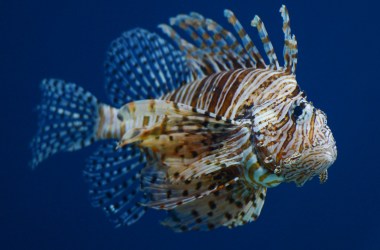
Bristling with venomous spines and possessed of a voracious appetite, lionfish have joined a growing list of invasive species infiltrating U.S. land and water. But an unusual partnership of conservationists and cooks argue that some of the best weapons to attack these invaders are the knife and fork. For species that have proven almost impossible to contain, whether feral boar or creeping kudzu, advocates embrace an “if you can’t beat them, eat them” ethos. Dubbed invasivores, a portmanteau of ‘locavore’ and ‘invasive,’ the catchphrase proudly puts invasive species on the ... Read More

T.C. Boyle Interview: Nature and the Novelist

Mankind's relationship with the natural world has dominated the news of late, with terrifying images of tsunami damage and well-founded fears of nuclear contamination. But even during periods when we don’t seem quite so puny or powerless, the topic captivates T.C. Boyle. The much-honored and best-selling novelist often writes about people who take a hubristic attitude toward nature, assuming they can either tame it or bend it to meet their own needs. The natural world tends to elbow its way past their arrogance, or idealism, or combination of the two, vividly revealing the scope of their ... Read More

Tracking Invasive Species from Riverside to Pandora

Tracking Invasive Species from Riverside to Pandora

While you may have been distracted by the whir of Navi flyers or distraught by a translucent plotline or even nauseated by your 3-D glasses, chances are if you saw James Cameron's Avatar last year, you spent very little time focused on its plant life. Yet there is one unnamed Pandora player whose contributions, touted recently by the theatrical run of Avatar's special edition release, whose entire 15 minutes of Hollywood acclaim came because of those fronds. A professor of plant physiology and former chair of the department of botany and plant sciences at the University of California, ... Read More

Snakeheads: the Asian Fish That Terrified Arkansas

Snakehead

Lee Holt, a biologist with the Arkansas Game & Fish Commission, aims his Chevy Silverado south, heading from his field office in Brinkley, Ark., out to the rice and soybean farms that surround this small Delta town. It's a hot, sticky summer day, and the A/C is thrumming inside the cab as Holt passes a Lutheran church on Highway 49 with a marquee that reads, "We Don't Serve A Wimpy God." This is the same road that he traversed a few months earlier, when he got a call from Russell Bonner's farm that changed his life and launched a sort of paranoia — and eventually an unprecedented ... Read More

Invasive Weeds? There’s An App for That

Cell phone users not content to text and chat can put their minutes to good use for the National Park Service. Resource managers working in national parks have a new tool in their arsenal to monitor and control invasive weeds. The Center for Embedded Networked Sensing lab at the University of California, Los Angeles, and the Santa Monica Mountains National Recreation Area, have joined forces to create a mobile application to help locate and eradicate harmful non-native plants found in environmentally sensitive public areas. Commonly referred to as apps, mobile applications have turned ... Read More