It’s easy to preach about the importance of energy conservation. But are people in the left really willing to sacrifice personal comfort in the name of environmental protection? Newly published research focusing on electricity usage suggests the answer is yes. Two UCLA economists report that, in the area served by an unnamed utility in the Western United States, households headed by registered Democrats use less electricity than those headed by registered Republicans. This holds true after factoring in variables such as climate, the price of electricity, and the size and age of the ... Read More
Consider the Crawdad

Recently dubbed the “ultimate survivor” by British biologists, the Louisiana red swamp crawdad and its globe-trotting adventures have made it the poster crustacean for pluck in the face of adversity. As legends go, the American export, a Gulf Coast native, first landed in Africa in the 1960s. Despite harsh conditions, food scarcity, and fierce predators, the swamp crawdad thrived—and today boasts progeny across the continent. In these challenging social and economic times, the crawdad’s superior coping skills have caught the attention of scientists the world over. Herewith, the ... Read More
Nepalese Tigers Figure Out How To Avoid Rush Hour

Via Kate Shaw at Ars Technica: We don't necessarily need to separate human and animal populations to protect them from each other, if the adaptations of tigers in a Nepal nature reserve show us anything. Biologists from Michigan State University set up 80 or so automatic cameras around Chitwan national park, a Bengal Tiger habitat, hoping to record the animal's schedule. The cameras captured not just tiger activity, but also humans who live in and near the park. Analyzing the video revealed that both human and tiger used the same paths and populated the same areas. The two groups ... Read More
Save the Trees, We’ll Save Your Life

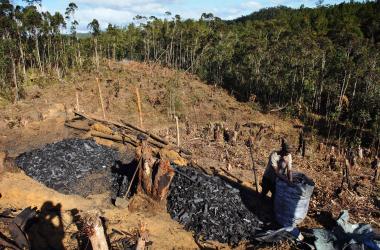
IN JULY 2011, about a week before I landed in Western Borneo, a local man sent an ominous text message to his boss from deep within the jungle. For more than 10 years, this man had worked as a research assistant at the Cabang Panti Research Station, in the core of Gunung Palung National Park, a mountainous wilderness that contains some of Indonesia’s last lowland rain forest and remains a stronghold for orangutans, gibbons, and other primates. Like many protected areas in the developing world, Gunung Palung’s boundaries were poorly enforced, and the people from the hardscrabble communities ... Read More
It’s a Gull-Eat-Whale World Out There, Thanks to People

A month ago ecologist Leah Gerber asked our readers to consider a biodiversity conundrum—in preserving a natural habitat, how should humans react when one struggling species starts edging a more critically threatened one toward extinction. In this case it was Galapagos sharks snacking on monk seals in the Papahānaumokuākea Marine National Monument; the National Marine Fisheries Service has called for culling the sharks. The dilemma about conservation triage arises because we have to hold two logically inconsistent ideas to view it—a preserve assumes that humans aren’t involved, yet ... Read More
LOST at Sea

Besides its unfortunate acronym, LOST, how else can you explain the perpetually doomed status of the United Nations Convention Law of the Sea treaty? LOST, first adopted in 1982, would create a uniform set of laws for the sea—governing fishing, piracy, territory, and mining—and an international regulatory body, and has been ratified by 161 countries, leaving the U.S. in the company of 35 naysayers that include North Korea, Iran, and Burundi. It’s unlikely we’ll be joining the rest of the world this year—earlier this month two more Republican senators joined the group of ... Read More
Conservation’s Earnest Message Could Use Levity
In a move that stunned environmentalists across the globe: the Coalition of Financially Challenged Countries with Lots of Trees (CoFCCLoT) recently recommended reforesting G8 nations back to pre-industrial levels in the hopes of countering the ravages of climate change. The coalition also has called for reintroducing gorillas into Spain and lions into Greece with the goal of revitalizing the ailing Eurozone economies. OK, the CoFCCLot doesn’t really exist, despite the press release cited above sent out last April 1. But the ersatz organization’s founders, Erik Meijaard and Douglas ... Read More
Alligator River Refuge Rolls Back From Rising Sea
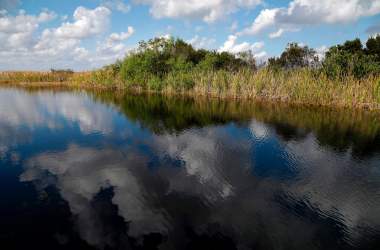
Standing on a beach on the Albemarle Peninsula in North Carolina, Brian Boutin, a Nature Conservancy biologist, points to a rusted piece of rebar with a green tag a few inches from the water’s edge. “That was our original marker to show what was happening here three years ago,” he says. “It was 20 meters from the shoreline. Now, it is the shoreline.” To the south, waves hit the shore and explode into the air, little eruptions of erosion. To the north, the waves break, but more gently. Offshore, Boutin and his Nature Conservancy colleagues have built 500 feet of reefs designed to ... Read More
Marketing the Mystery of the Giant Squid
The new canary in the coal mine could be a giant squid. Conservation efforts often rally around charismatic species like the African elephant or the bald eagle. Popular affection for these "flagship" animals can be leveraged into funding and political will. But who speaks for the 95 percent of Earth's inhabitants without a backbone? No worm has the rock-star appeal of a Bengal tiger. Enter the giant squid. Ángel Guerra, a research professor at CSIC (the National Research Council of Spain), makes the case for turning this unusual animal, the largest invertebrate in the world, into a ... Read More