

Over the past 15 years, the fashion industry has undergone a profound and baffling transformation. What used to be a stable three-month production cycle—the time it takes to design, manufacture, and distribute clothing to stores, in an extraordinary globe-spanning process—has collapsed, across much of the industry, to just two weeks. The “on-trend” clothes that were, until recently, only accessible to well-heeled, slender urban fashionistas, are now available to a dramatically broader audience, at bargain prices. A design idea for a blouse, cribbed from a runway show in Paris, can make it onto the racks in Wichita in a wide range of sizes within the space of a month.
Popularly known as “fast fashion,” this trend has inspired a great deal of media attention, but not many satisfying explanations as to how this huge shift came about, especially in the United States, and why it happened when it did. Some accounts attribute the new normal to top-down “process innovations” at big companies like Inditex, the parent company of Zara and the world’s largest—but hardly most typical—fast-fashion retailer. And at times, popular writing has simply lumped fast fashion in with the generally sped-up pace of life in the digital age, as if complex industrial systems were as fluid as our social media habits.
So the questions remain: Who is designing and manufacturing these garments in the U.S.? How are so many different suppliers producing such large volumes of clothes so quickly, executing coordinated feats of design, production, and logistics in a matter of days?
For my own part, I went looking for the answers in church.
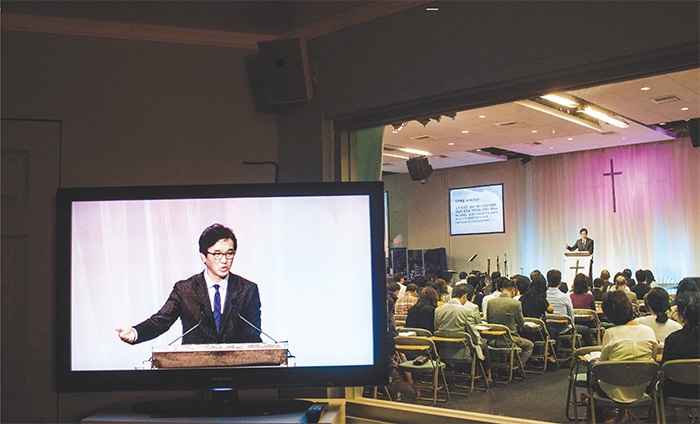
GARMENT OF PRAISE: The Ttokamsa Home Mission Church in eastern Los Angeles is the spiritual home of many of the Korean families who produce fast fashion, including the Chang family—the owners of Forever 21. (Photo: Lauren Lancaster)
Specifically, I paid a visit this past summer to the Ttokamsa Home Mission Church, a large, gray, industrial box of a building near a highway on the edge of Echo Park, a residential neighborhood in East Los Angeles. A well-known local institution among Korean Americans, the church is the spiritual home of the Chang family—the owners of Forever 21, the largest fast-fashion retailer based in the U.S. (Look on the bottom of any canary-yellow Forever 21 shopping bag and you’ll find the words “John 3:16.”)
With more than 630 locations worldwide, the Changs’ retail empire employs more than 35,000 people and made $3.7 billion in revenue in 2012. But in the pews at Ttokamsa, the Changs are in good company: The vast majority of their fellow parishioners are Korean families that also make their livelihoods in fast fashion.
As an anthropologist, I have been coming to Los Angeles with the photographer Lauren Lancaster for the past two years to study the hundreds of Korean families who have, over the last decade, transformed the city’s garment district into a central hub for fast fashion in the Americas. These families make their living by designing clothes, organizing the factory labor that will cut and sew them in places like China and Vietnam, and selling them wholesale to many of the most famous retailers in the U.S.—including Forever 21, Urban Outfitters, T.J. Maxx, Anthropologie, and Nordstrom.
I first became curious about the garment sector in Los Angeles after noticing that an increasingly large proportion of students at Parsons, the New York design school where I teach, were second-generation children of Korean immigrants from Southern California. Many of them were studying fashion marketing and design so they could return to Los Angeles to help scale up their parents’ businesses. These students and their contemporaries were, I came to understand, the driving force behind U.S. fast fashion—a phenomenon whose rise is less a story about corporate innovation than one about an immigrant subculture coming of age.
(Photo: Lauren Lancaster)
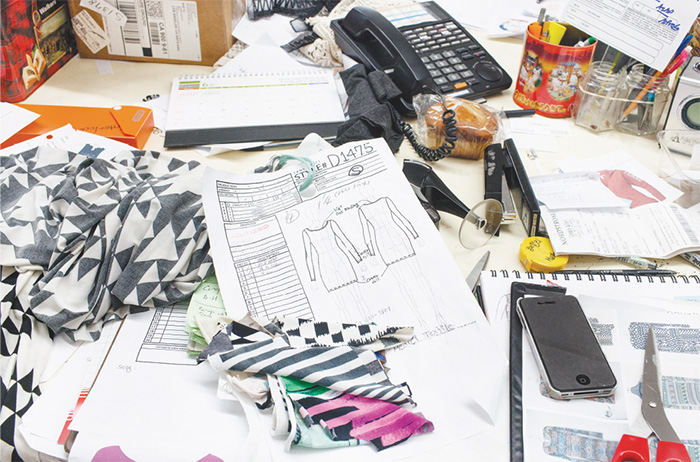
THE NERVE CENTER OF fast fashion in America is a sprawling, 30-square-block neighborhood in downtown LA loosely known as the Jobber Market. The term “jobber,” a holdover from the days when Jewish and Iranian vendors dominated the neighborhood, refers to the wholesalers and middlemen who historically trafficked in downmarket clothing there. But the neighborhood’s name and reputation are outdated in a couple of ways: Today pretty much everyone who works there is either Korean or Mexican, and many of the businesses born in the area now design, manufacture, and wholesale their own garments for prominent markets.
These young Koreans are the driving force behind fast fashion—a phenomenon whose rise is less a story about corporate innovation than one about an immigrant subculture coming of age.
Thousands of glass-fronted ground-floor showrooms, set into long single-or two-story buildings, line the streets. The sidewalks bustle with deliveries and pedestrians. Mannequins flank each entrance, displaying garments unpacked from the shipping containers that arrive daily from Asia at the Port of Los Angeles.
The showrooms are staffed in a remarkably consistent pattern: Korean husband-and-wife teams own the shops and run them alongside their children; Mexican husband-and-wife teams serve as salespeople or inventory workers and packers. And everyone is styled in the neighborhood’s latest fashions—which will, in turn, become the rest of the country’s latest fashions before long.
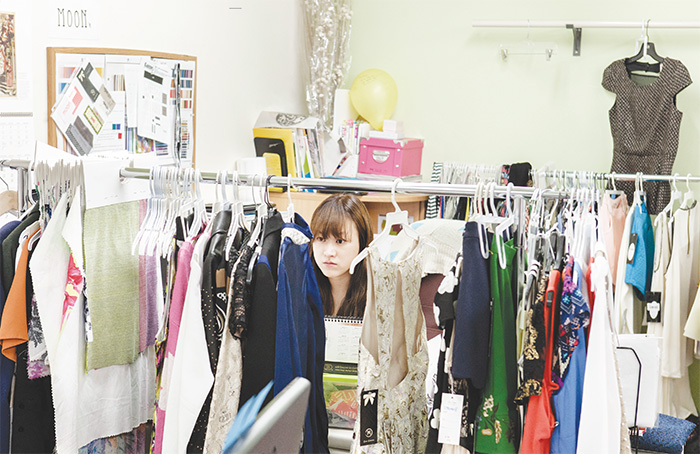
NEXT TOP MODEL: Design studio at a garment business in L.A.’s Jobber Market. The rise of a new generation of design-savvy young Korean’s in L.A.’s garment sector has propelled the fast-fashion trend. (Photo: Lauren Lancaster)
Even for an insider, it’s hard to get a sense of the scale of what’s going on in the Jobber Market. About 3,000 businesses are officially registered with the Korean Apparel Manufacturers Association of Los Angeles. But people in the neighborhood will tell you that more than 6,000 Korean-owned clothing labels operate there. Some of them are just small-time mom-and-pop establishments; others are multimillion-dollar businesses. Gossip and rumor pervade the neighborhood—about who is doing well and who isn’t; about who secretly owns a massive warehouse and manufacturing operation, and who has little but a flashy showroom.
How did this neighborhood become what it is? The answer lies in a 50-year process of migration and generational progress—one that has recently reached a kind of critical mass.
South Korea industrialized largely through its garment sector during the 1960s and ’70s, making clothes for the U.S. export market. In the cities and the countryside alike, practically an entire generation of Koreans—a staggering proportion of the adult population—cut their teeth working in these factories. At the same time, Korea was still an impoverished country with high unemployment and an oppressive military regime. So thousands of Koreans fled, emigrating mainly to the U.S. and South America—in particular to Brazil and Argentina.
Without language skills or money, most ended up leveraging their ties to the textile trade back home, making or selling clothes. Korean immigrants went on to play large roles in the most important clothing markets in São Paulo, Buenos Aires, Guangzhou, L.A., and New York. “All of us—every single person I knew—ended up working in the clothing business, even after graduating with a university degree,” says Mike Lee, a Korean fashion entrepreneur who came to Los Angeles from Brazil. “It was just one of those things where it was easy to learn the business and easy to get information about it, because everyone doing clothing in São Paulo was Korean.”

INDUSTRIAL SUPPLY: Some firms in the Jobber Market—like Sans Souci, a women’s apparel company—have major warehouse operations. Others get by with just a showroom. (Photo: Lauren Lancaster)
Then, during the late 1980s and throughout the 1990s, thousands of Korean garment-business owners left Brazil and Argentina for Los Angeles, driven by currency crises, inflation, rising crime, and the search for better educational opportunities for their children. It was those same children who would go on to drive America’s fast-fashion revolution.
THE IMMIGRANT ENTREPRENEURS WHO set up shop in the Los Angeles garment district up through the 1990s brought with them decades of industry experience. They understood pattern-making, fit, and quality control; and their diasporic connections to other Koreans working abroad in the trade connected them to fabric and trim sources, factories, managers, sample-makers, and sewers in places like Brazil, China, and Vietnam.
What they lacked, often, was American cultural fluency, a sensibility for aesthetics and design, and the capacity to connect with American retailers—traits that were becoming increasingly necessary for survival. By 2000, by many accounts, a large swath of garment businesses were failing. Korean-owned sewing factories, cutting studios, and small-time manufacturers were going belly-up in waves. The industry was changing.
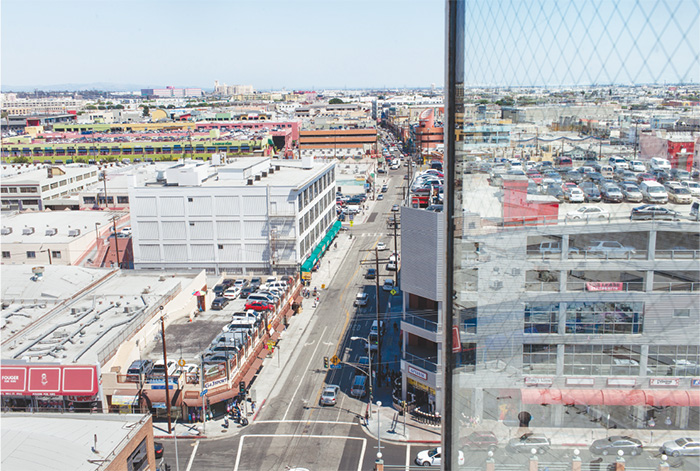
The Jobber Market stretches out. (Photo: Lauren Lancaster)
Gone were the days when a garment shop just took orders from companies to create basic designs (imagine a shirt from the Gap circa 1995) that would continue to sell for several seasons. Big retailers were doing a lot less of their own designing, while requiring more complicated details and features in trim and ornamentation. “Before, as long as there was a hole for the head and a sleeve, you could sell [a shirt] with any print,” says So Yun, the designer for a Jobber Market company called Collective Concepts. “Now it’s designed.”
Only businesses with a honed sense of fashion trends could survive. And with more and more Koreans arriving to open up wholesale shops and showrooms, competition became cutthroat.
In the 2000s, the first major wave of second-generation Korean immigrants— kids who had grown up around their parents’ showrooms—started hitting adulthood. They headed off to American universities to study business, or to schools like Parsons to acquire skills in design, marketing, and merchandising. “They are going to fashion schools everywhere—in Paris, London, Milan, L.A., and New York, all over the world,” says Tommy Choi, a 15-year veteran of the Jobber Market.
On their return to Los Angeles, the kids revamped their family businesses: re-branding, creating company logos, building out showroom spaces to make them appealing to American wholesale buyers, and setting up sleek websites. Their Americanized cultural identities and native English skills allowed Jobber Market businesses to communicate fluently with domestic department-store and retail buyers. And their design, marketing, and merchandising skills allowed companies in the neighborhood to start making clothes on the cutting edge of fashion.
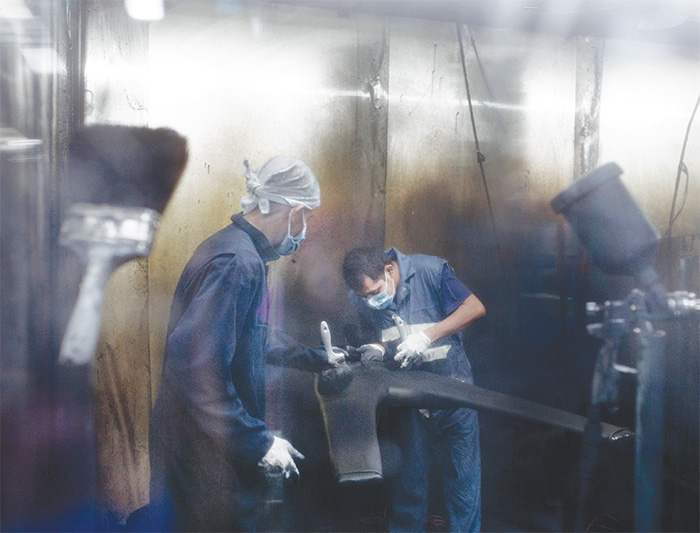
FIELD OF JEANS: Koos Manufacturing Inc., a Korean-owned factory in the Southgate neighborhood of L.A. is one of the nation’s largest denim manufacturers. It does its own design, cutting, sewing, finishing, and more. (Photo: Lauren Lancaster)
This simple change had a profound effect: It brought nearly all the parts of the apparel cycle—design, production, logistics, wholesaling, and marketing—under the purview of individual Korean fashion businesses. The levels of trust and coordination within each family business boosted the efficiency of the global production process. And the fierce competition between young Koreans in these family businesses sparked an explosion of creativity.
In 1984, Forever 21 was a single retail store in the East L.A. neighborhood of Highland Park. By 2001, the company had 50 stores. The retailer continued to gain a following because it stocked so many on-trend, knock-off garments, offering new designs almost daily. By many accounts, this constant stream of styles—the secret to Forever 21’s original success—came from the Jobber Market.
Competing against retailers that were still observing the three-month fashion cycle, Forever 21’s buyers only needed to show up daily in the Jobber Market and choose from a smorgasbord of fashion-forward designs, all ready to be shipped that day. If the company’s buyers did not agree with one vendor’s price, all they had to do was go next door, where a similar design could likely be had for cheaper.
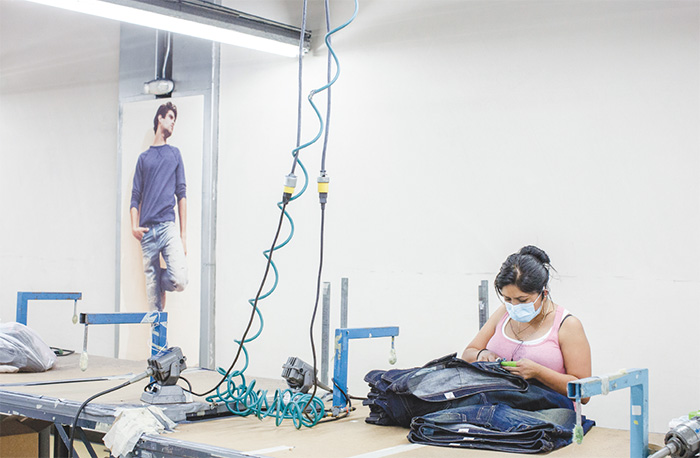
Koos Manufacturing Inc. (Photo: Lauren Lancaster)
Today, Forever 21 has its own warehouses abroad to keep up with global demand, but it still maintains some ties to the Korean garment district. The company sends agents to the neighborhood—and to other similar markets around the world—to check in with vendors and keep track of what’s trending where. And several manufacturers in the neighborhood say that Forever 21 still buys clothes from them.
There’s one more important part of the picture: Fast fashion did not just arise from a new intergenerational division of labor within Korean fashion businesses. It also arose from a new distribution of risk in the industry, with much of it falling on the shoulders of the Korean and Mexican families near the bottom of the production chain. For the fast-fashion suppliers in the L.A. Jobber Market, consumer demands are unpredictable and the market is highly volatile. Wholesalers live at the mercy of retailers who set prices and squeeze profit margins; families must invest cash and put thousands of styles into production before knowing what will sell. Everyone in the Jobber Market tells me about the stress, likening the business to gambling at a casino.
Even sitting in her room, Alice looks effortlessly fashionable. She’s wearing little black pleather shorts and a cute baseball T-shirt. These could be items in somebody’s haul video. But everything that Alice Moon is wearing is something her own family has designed and made.
FAR BEYOND THE CONFINES of the Los Angeles garment district, one of the most striking hallmarks of the fast-fashion era is the rise of the YouTube “haul” video. A typical haul video—so named for the overstuffed bags of clothing one can purchase from a fast-fashion outlet for relatively little money—shows a young woman, just home from shopping, pulling out new purchases and showing them off for the camera. The videos exemplify the new dynamics of fashion consumption in America: the sheer cheapness, the low barriers to gratification, the disposability of stylish clothing. As one star of a haul video recently said, “I bought these jeans just because it was a $6-denim day at Forever 21.”
On a residential street in Glendale, California, Alice Moon’s bedroom does not look so different from the kind of backdrop one often sees in haul videos. It is decorated with cut-and-paste collages of clothes, runway models, and magazine cover girls. She’s cut the word “fashion” out in bubble letters and strung it decoratively across one wall. Shopping bags are strewn about everywhere—from H&M, Zara, Forever 21—stuffed with clothing that has yet to be unpacked, folded, put away, or even worn.
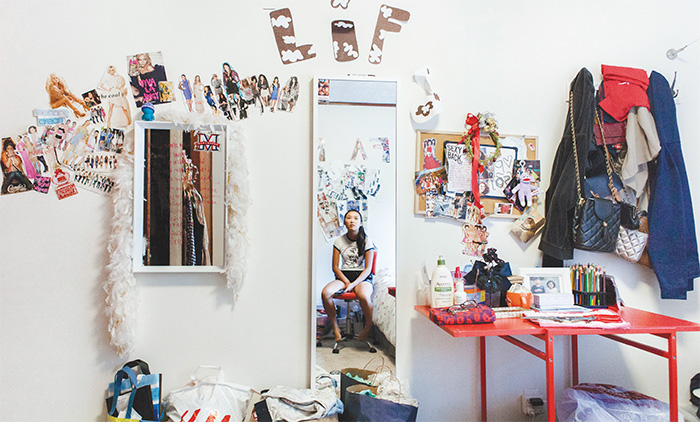
UP AND COMING: Alice Moon, the teenage daughter of a fast fashion family and a parishioner at the Ttokamsa Home Mission Church, in her room in Glendale. After she graduates high school, Moon hopes to study fashion design at Parsons. (Photo: Lauren Lancaster)
Moon (no relation to me) is a parishioner at the Ttokamsa church, the daughter of a fast-fashion family with a business in the Jobber Market. A junior in high school, Alice tells me that after she graduates, she too hopes to attend Parsons to study fashion design; she has already made her first campus visit. She grew up helping out behind the store counter, navigating among boxes in the warehouse, peering over shoulders in the design studio, and modeling clothes. She’s always been a part of the design process one way or another, she says.
Alice’s mom, the main designer in the family, tells me her daughter has come along on several trips to Paris, Milan, and London—to fabric shows and trade shows, and on shopping and research trips to help the family stay abreast of unfolding global trends. Alice is clearly being ably groomed for the family business, although her parents tell me she may pursue whatever makes her happy.
Even sitting in her room, Alice looks effortlessly fashionable. With her hair tied up in a ponytail, she’s wearing little black pleather shorts and a cute baseball T-shirt. These could be items in somebody’s haul video—and indeed, maybe they are, somewhere on the Internet. But everything that Alice Moon is wearing is something that her own family designed and made.
This post originally appeared in the March/April 2014 issue of Pacific Standard as “The Slow Road to Fast Fashion.” For more, subscribe to our print magazine.