


The term secularization is typically used to describe the process by which something becomes increasingly distant from, irrelevant to, or uninfluenced by religion. But what about religions themselves? Can religions undergo secularization?
Sociologist Jeremy Thomas tested this proposition, looking at changes in how authors writing for the popular magazine Christianity Today frame their opposition to the use of pornography between 1956 and 2010 (article, summary). He compared three anti-pornography frames:
- religious (e.g., against the bible, a sin)
- harm to others (e.g., performers)
- harm to self (e.g., porn addiction, marital troubles)
Thomas found that the last frame—harm to self—had increasing come to dominate the discussion at Christianity Today. This figure shows the proportion of paragraphs that make each argument. The last frame clearly dominates.
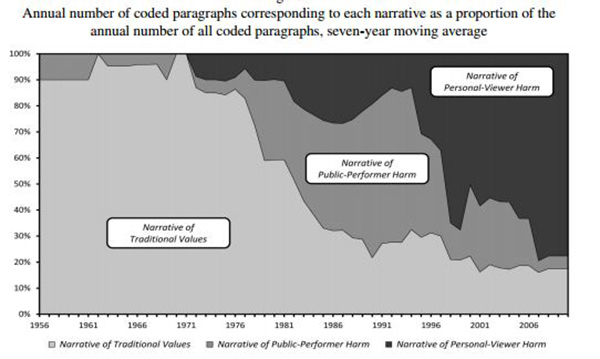
Thomas calls this “outsourcing moral authority”—religious leaders are relying on other authorities to back up their points of view. This suggests that even religion is undergoing secularization.
This post originally appeared on Sociological Images, a Pacific Standard partner site.