

Jonathan Haidt is hardly a road-rage kind of guy, but he does get irritated by self-righteous bumper stickers. The soft-spoken psychologist is acutely annoyed by certain smug slogans that adorn the cars of fellow liberals: “Support our troops: Bring them home” and “Dissent is the highest form of patriotism.”
“No conservative reads those bumper stickers and thinks, ‘Hmm — so liberals are patriotic!'” he says, in a sarcastic tone of voice that jarringly contrasts with his usual subdued sincerity. “We liberals are universalists and humanists; it’s not part of our morality to highly value nations. So to claim dissent is patriotic — or that we’re supporting the troops, when in fact we’re opposing the war — is disingenuous.
“It just pisses people off.”
The University of Virginia scholar views such slogans as clumsy attempts to insist we all share the same values. In his view, these catch phrases are not only insincere — they’re also fundamentally wrong. Liberals and conservatives, he insists, inhabit different moral universes. There is some overlap in belief systems, but huge differences in emphasis.

In a creative attempt to move beyond red-state/blue-state clichés, Haidt has created a framework that codifies mankind’s multiplicity of moralities. His outline is simultaneously startling and reassuring — startling in its stark depiction of our differences, and reassuring in that it brings welcome clarity to an arena where murkiness of motivation often breeds contention.
He views the demonization that has marred American political debate in recent decades as a massive failure in moral imagination. We assume everyone’s ethical compass points in the same direction and label those whose views don’t align with our sense of right and wrong as either misguided or evil. In fact, he argues, there are multiple due norths.
“I think of liberals as colorblind,” he says in a hushed tone that conveys the quiet intensity of a low-key crusader. “We have finely tuned sensors for harm and injustice but are blind to other moral dimensions. Look at the way the word ‘wall’ is used in liberal discourse. It’s almost always related to the idea that we have to knock them down.
“Well, if we knock down all the walls, we’re sitting out in the rain and cold! We need some structure.”

Haidt is best known as the author of The Happiness Hypothesis, a lively look at recent research into the sources of lasting contentment. But his central focus — and the subject of his next book, scheduled to be published in fall 2010 — is the intersection of psychology and morality. His research examines the wellsprings of ethical beliefs and why they differ across classes and cultures.
Last September, in a widely circulated Internet essay titled Why People Vote Republican, Haidt chastised Democrats who believe blue-collar workers have been duped into voting against their economic interests. In fact, he asserted forcefully, traditionalists are driven to the GOP by moral impulses liberals don’t share (which is fine) or understand (which is not).
To some, this dynamic is deeply depressing. “The educated moral relativism worldview is fundamentally incompatible with the way 50 percent of America thinks, and stereotypes about out-of-touch elitist coastal Democrats are basically correct,” sighed the snarky Web site Gawker.com as it summarized his studies.
But others — including many fellow liberal academics — have greeted Haidt’s ideas as liberating.
“Jonathan is a thoughtful and somewhat flamboyant theorist,” says Dan McAdams, a Northwestern University research psychologist and award-winning author. “We don’t have that many of those in academic psychology. I really appreciate his lively mind.”
“Psychology, as a field, has lots and lots of data, but we don’t have very many good new ideas,” agrees Dennis Proffitt, chairman of the University of Virginia psychology department. “They are rare in our field, but Jon is full of good new ideas.”
An unapologetic liberal atheist, Haidt has a remarkable ability to describe opposing viewpoints without condescension or distortion. He forcefully expresses his own political opinions but understands how they are informed by his underlying moral orientation. In an era where deadlocked debates so often end with a dismissive “you just don’t get it,” he gets it.
Four years ago, he recalls, “I wanted to help Democrats press the right buttons because the Republicans were out-messaging them.
“I no longer want to be a part of that effort. What I want to do now is help both sides understand the other, so that policies can be made based on something more than misguided fear of what the other side is up to.”
Haidt’s journey into ethical self-awareness began during his senior year of high school in Westchester County, N.Y. “I had an existential crisis straight out of Woody Allen,” he recalls. “If there’s no God, how can there be a meaning to life? And if there’s no meaning, why should I do my homework? So I decided to become a philosophy major and find out the meaning of life.”

Once he began his studies at Yale, however, he found philosophy “generally boring, dry and irrelevant.” So he gradually gravitated to the field of psychology, ultimately earning his doctorate at the University of Pennsylvania. There he met several influential teachers, including anthropologist Alan Fiske and Paul Rozin, an expert on the psychology of food and the emotion of disgust. Fascinated by Rozin’s research, Haidt wrote his dissertation on moral judgment of disgusting but harmless actions – a study that helped point the way to his later findings.
As part of that early research, Haidt and a colleague, Brazilian psychologist Silvia Koller, posed a series of provocative questions to people in both Brazil and the U.S. One of the most revealing was: How would you react if a family ate the body of its pet dog, which had been accidentally run over that morning?
“There were differences between nations, but the biggest differences were across social classes within each nation,” Haidt recalls. “Students at a private school in Philadelphia thought it was just as gross, but it wasn’t harming anyone; their attitude was rationalist and harm-based. But when you moved down in social class or into Brazil, morality is based not on just harm. It’s also about loyalty and family and authority and respect and purity. That was an important early finding.”
On the strength of that paper, Haidt went to work for Richard Shweder, a cultural anthropologist at the University of Chicago who arranged for his postdoc fellow to spend three months in India. Haidt refers to his time in Bhubaneshwar — an ancient city full of Hindu temples that retains a traditional form of morality with rigid cast and gender roles — as transformative.
“I found there is not really a way to say ‘thank you’ or ‘you’re welcome’ (in the local language),” he recalls. “There are ways of acknowledging appreciation, but saying ‘thank you’ and ‘you’re welcome’ didn’t make any emotional sense to them. Your stomach doesn’t say ‘thank you’ to your esophagus for passing the food to it! What I finally came to understand was to stop acting as if everybody was equal. Rather, each person had a job to do, and that made the social system run smoothly.”
Gradually getting past his reflexive Western attitudes, he realized that “the Confucian/Hindu traditional value structure is very good for maintaining order and continuity and stability, which is very important in the absence of good central governance. But if the goal is creativity, scientific insight and artistic achievement, these traditional societies pretty well squelch it. Modern liberalism, with its support for self-expression, is much more effective. I really saw the yin-yang.”
After returning to the U.S., Haidt accepted a position at the University of Virginia, where he continued to challenge the established wisdom in moral psychology. His colleagues were using data from middle-class American college students to draw sweeping conclusions about human nature. Proffitt remembers him arguing “with some passion” that they needed to widen their scope.
“Jon recognizes that diversity is not just the politically correct thing to do – it’s also the intelligent thing to do,” he says. “Seeing things from multiple perspectives gives you a much better view of the whole.”
In January 2005 — shortly after President Bush won re-election, to the shock and dismay of the left — Haidt was invited by a group of Democrats in Charlottesville, Va., to give a talk on morality and politics. There, for the first time, he explained to a group of liberals his conception of the moral world of cultural conservatives.
“They were very open to what I was saying,” he says. “I discovered there was a real hunger among liberals to figure out what the hell was going on.”
Haidt’s framework of political morality can be traced back to a dispute between two important thinkers: Shweder, who would go on to become his mentor, and legendary Harvard psychologist Lawrence Kohlberg. In his 1981 volume The Philosophy of Moral Development, Kohlberg essentially argued that other moral systems are mere stepping-stones on a path that will eventually lead the entire world to embrace Western humanist values. Reviewing the book for the journal Contemporary Psychology, Shweder politely but effectively tore that notion apart.
Citing his extensive research on traditional Indian culture, Shweder pointed out the inconsistencies and lack of convincing evidence behind Kohlberg’s arguments. Agreeing with philosopher Isaiah Berlin, Shweder asserted — and continues to assert — that a range of ethical systems have always coexisted and most likely always will. In a 1997 paper co-written with three colleagues, he broke down primal moral impulses into a “big three”: autonomy, community and divinity.

Haidt found Shweder’s ideas persuasive but incomplete. Agreeing with evolutionary theorist James Q. Wilson, he concluded that any full view of the origins of human morality would have to take into account not only culture (as analyzed by anthropologists) but also evolution. He reasoned it was highly unlikely humans would care so much about morality unless moral instincts and emotions had become a part of human nature. He began to suspect that morality evolved not just to help individuals as they competed and cooperated with other individuals, but also to help groups as they competed and cooperated with other groups.
“Morality is not just about how we treat each other, as most liberals think,” he argues. “It is also about binding groups together and supporting essential institutions.”
With all that in mind, Haidt identified five foundational moral impulses. As succinctly defined by Northwestern University’s McAdams, they are:
• Harm/care. It is wrong to hurt people; it is good to relieve suffering.
• Fairness/reciprocity. Justice and fairness are good; people have certain rights that need to be upheld in social interactions.
• In-group loyalty. People should be true to their group and be wary of threats from the outside. Allegiance, loyalty and patriotism are virtues; betrayal is bad.
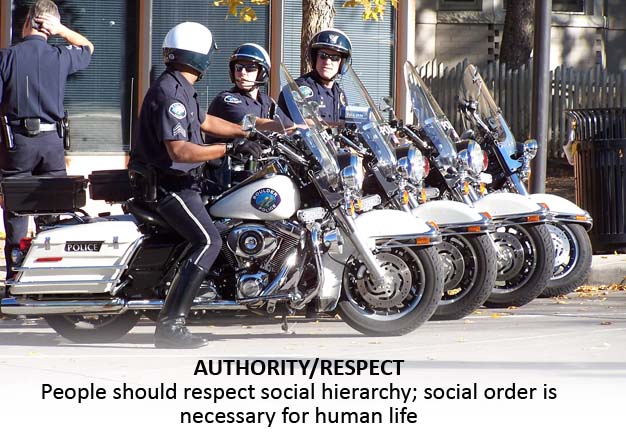
• Authority/respect. People should respect social hierarchy; social order is necessary for
human life.
• Purity/sanctity. The body and certain aspects of life are sacred. Cleanliness and health, as well as their derivatives of chastity and piety, are all good. Pollution, contamination and the associated character traits of lust and greed are all bad.
Haidt’s research reveals that liberals feel strongly about the first two dimensions — preventing harm and ensuring fairness — but often feel little, or even feel negatively, about the other three. Conservatives, on the other hand, are drawn to loyalty, authority and purity, which liberals tend to think of as backward or outdated. People on the right acknowledge the importance of harm prevention and fairness but not with quite the same energy or passion as those on the left.
Libertarian essayist Will Wilkinson of the Cato Institute — one of many self-reflective political thinkers who are intrigued by Haidt’s hypothesis — puts it this way: “While the five foundations are universal, cultures build upon each to varying degrees. Imagine five adjustable slides on a stereo equalizer that can be turned up or down to produce different balances of sound. An equalizer preset like ‘Show Tunes’ will turn down the bass and ‘Hip Hop’ will turn it up, but neither turns it off.
“Similarly, societies modulate the dimension of moral emotions differently, creating a distinctive cultural profile of moral feeling, judgment and justification. If you’re a sharia devotee ready to stone adulterers and slaughter infidels, you have purity and in-group pushed up to 11. PETA members, who vibrate to the pain of other species, have turned in-group way down and harm way up.”
McAdams was first exposed to these ideas about three years ago, when he heard Haidt speak at a conference. Around that same time, he was analyzing information he had compiled from interviews with 150 highly religious middle-aged Americans — men and women from across the political spectrum who had described in detail the ways they find meaning in their lives. Realizing this was an excellent test case for Haidt’s theories, McAdams started comparing the comments of self-described liberals and conservatives.
Sure enough, “Conservatives spoke in moving terms about respecting authority and order,” he found. “Liberals invested just as much emotion in describing their commitment to justice and equality. Liberals feel authority is a minor-league moral issue; for us, the major leaguers are harm and fairness.”
It’s hard to play ball when you can’t agree who deserves to be a big leaguer.
Of Haidt’s five moral realms, the one that causes the most friction between cosmopolitan liberals and traditionalist conservatives is purity/sanctity. To a 21st-century secular liberal, the concept barely registers. Haidt notes it was part of the Western vocabulary as recently as the Victorian era but lost its force in the early 20th century when modern rules of proper hygiene were codified. With the physical properties of contamination understood, the moral symbolism of impurity no longer carried much weight.
But the impulse remains lodged in our psyches, turning up in both obvious and surprising ways. You can hear strong echoes of it when the pope rails against materialism, insisting we have been put on Earth to serve a loftier purpose than shopping until we drop. It can also be found in the nondenominational spiritual belief that we all contain within us a piece of the divine. (Although it’s sometimes used in a tongue-in-cheek way in our society, the phrase “my body is a temple” is reflective of the purity/sanctity impulse.)
“The question is: Do you see the world as simply matter?” Haidt asks. “If so, people can do whatever they want, as long as they don’t hurt other people. Or do you see more dimensions to life? Do you want to live in a higher, nobler way than simply the pursuit of pleasure? That often requires not acting on your impulses, making sacrifices for others. It implies a reverence — which is a nonrational feeling — towards human life.”
Consider two letters to the editor in a recent issue of the Ventura (Calif.) Breeze. The weekly newspaper has been chronicling a controversy about a 19th-century cemetery that gradually fell into disrepair and, since the early 1960s, has been used as a dog park. Some descendents of the people buried there are demanding that it be restored as a proper burial place.
“Why is there even a debate?” wrote one angry resident. He referred to the park as “this holy ground” and admonished city officials: “Your values and judgment need some serious realignment.” But a second reader looked at the controversy from a more practical perspective, noting that public funds are limited in these tough economic times. Besides, he added, “the park is full of life now, and I’m sorry if this sounds harsh, but life is for the living.”
Both arguments are rooted in firm moral beliefs. It’s just that for the first correspondent, purity/sanctity is paramount, while for the second it’s of minimal importance.
Not surprisingly, Haidt’s data suggests purity/sanctity is the moral foundation that best predicts an individual’s attitude toward abortion. It also helps explain opposition to gay marriage. “If you think society is made up of individuals, and each individual has the right to do what he or she wants if they aren’t hurting anybody, it’s unfathomable why anyone would oppose gay marriage,” he says. “Liberals assume opponents must be homophobic.
“I know feelings of disgust do play into it. When you’re disgusted by something, you tend to come up with reasons why it’s wrong. But cultural conservatives, with their strong emphasis on social order, don’t see marriage primarily as an expression of one individual’s desire for another. They see the family as the foundation of society, and they fear that foundation is dissolving.”
Haidt doesn’t want religious fundamentalists dictating public policy to ensure it lines up with their specific moral code. Even if you perceive purity as a major-league issue, it doesn’t have to be on steroids. But he argues it is important that liberals recognize the strength that impulse retains with cultural conservatives and respect it rather than dismissing it as primitive.
“I see liberalism and conservatism as opposing principles that work well when in balance,” he says, noting that authority needs to be both upheld (as conservatives insist) and challenged (as liberals maintain). “It’s a basic design principle: You get better responsiveness if you have two systems pushing against each other. As individuals, we are very bad at finding the flaws in our own arguments. We all have a distorted perception of reality.”
Spend some time reading Haidt, and chances are you’ll begin to view day-to-day political arguments through a less-polarized lens. Should the Guantanamo Bay prison be closed? Of course, say liberals, whose harm/fairness receptors are acute. Not so fast, argue conservatives, whose finely attuned sense of in-group loyalty points to a proactive attitude toward outside threats.
Why any given individual grows up to become a conservative or a liberal is unclear. Haidt, like most contemporary social scientists, points to a combination of genes and environment — not one’s family of origin so much as the neighborhood and society whose values you absorbed. (Current research suggests that peers may actually have a stronger impact than parents in this regard.)
In his quest to “help people overcome morally motivated misunderstandings,” Haidt has set up a couple of Web sites, www.civilpolitics.org and www.yourmorals.org. At the latter, you can take a quiz that will locate you on his moral map. For fun, you can also answer the questions you think the way your political opposite would respond. Haidt had both liberals and conservatives do just that in the laboratory, and the results are sobering for those on the left: Conservatives understood them a lot better than they understood conservatives.
“Liberals tend to have a very optimistic view of human nature,” he says. “They tend to be uncomfortable about punishment — of their own children, of criminals, anyone. I do believe that if liberals ran the whole world, it would fall apart. But if conservatives ran the whole world, it would be so restrictive and uncreative that it would be rather unpleasant, too.”

The concept of authority resonates so weakly in liberals that “it makes it difficult for liberal organizations to function,” Haidt says. (Will Rogers was right on target when he proclaimed, “I don’t belong to an organized political party. I’m a Democrat.”) On the other hand, he notes, the Republicans’ tendency to blindly follow their leader proved disastrous over the past eight years.
“Look how horribly the GOP had to screw up to alienate many conservatives,” muses Dallas Morning News columnist and BeliefNet blogger Rod Dreher, an Orthodox Christian, unorthodox conservative and Haidt fan. “In the end, the GOP, the conservative movement and the nation would have been better served had we on the right not been so yellow-dog loyal. But as Haidt shows, it’s in our nature.”
Like Wilkinson, Dreher doesn’t fit cleanly into the left-right spectrum; he reports that taking Haidt’s test (showing he scored high on certain liberal values but also on some conservative ones) helped him understand why. He’s appreciative of that insight and admiring of the way the psychologist is able to set aside the inherent prejudice we all share in favor of our own moral outlook. “It’s hard for any of us to get outside our own heads and perform acts of empathy with people we don’t much like,” he notes.
In higher education, as in so many other fields, the best way to negotiate a pay raise is to get a competing offer. Not infrequently, an academic will entertain an offer from an institution he or she isn’t really interested in joining, specifically so he can get a salary offer, take it back to his current employer and demand it be matched.
Haidt found himself in just that situation a few years back. But as he explained to Proffitt, his department chair, he was uncomfortable with the notion of lying to gain leverage.
“He told me, ‘I know that if I was offered the position, I could get a big raise here. But I study ethics! I can’t do that! That would be wrong!’ He felt he wouldn’t be playing fair with the people from the other university, who were putting out money and effort to recruit him.”
“That game is played by a lot of people, but Jon would not,” Proffitt says. “He elected not to do that on purely ethical grounds. That decision cost him at least $30,000 a year.”
But was he guided by the harm/care instinct? Or fairness/reciprocity? Or did the conservative value of in-group loyalty, which tends to lie dormant in liberals such as Haidt, emerge under these unusual circumstances and convince him to be true to his school?
The most likely answer is “all of the above.” The point is Haidt realized the wrongness of that behavior in his gut and acted on instinct.
In making such decisions, he is setting a rigorous moral example for his son, Max, who turns 3 in July. Haidt would be pleased if, by the time Max gets to secondary school, the study of ethics is part of the curriculum. “If I had my way, moral psychology would be a mandatory part of high-school civics classes, and civics classes would be a mandatory part of all Americans’ education,” he says. “Understanding there are multiple perspectives on the good society, all of which are morally motivated, would go a long way toward helping us interact in a civil manner.”
Shweder cheers him on in that crusade. “I think this is terribly important,” he says. “People are not going to converge on their judgments of what’s good or bad, or right and wrong. Diversity is inherent in our species. And in a globalized world, we’re going to be bumping into each other a lot.”
Whether they’re addressing the U.S. Congress or U.N. General Assembly, Haidt has astute advice for policy advocates: Frame your argument to appeal to as many points as possible on the moral spectrum. He believes President Obama did just that in his inaugural address, which utilized “a broad array of virtue words, including ‘courage,’ ‘loyalty,’ ‘patriotism’ and ‘duty,’ to reach out and reassure conservatives.”
Haidt notes that the environmental movement was started by liberals, who were presumably driven by the harm/care impulse. But conservative Evangelical Christians are increasingly taking up the cause, propelled by the urge to respect authority. “They’re driven by the idea that God gave man dominion over the Earth, and keeping the planet healthy is our sacred responsibility,” he notes. “If we simply rape, pillage, destroy and consume, we’re abusing the power given to us by God.
“The climate crisis and the economic crisis are interesting, because neither has a human enemy. These are not crises that turn us against an out-group, so they’re not really designed to bring us together, but they can be used for that. I hope and think we are ready, demographically and historically, for a less polarized era.”
But that will require peeling off some bumper stickers. Contrary to the assertion adhered onto Volvos, dissent and patriotism are very different impulses. But Haidt persuasively argues that both are essential to a healthy democracy, and the interplay between them — when kept within respectful bounds — is a source of vitality and strength. “Morality,” he insists, “is a team sport.”
Sign up for our free e-newsletter.
Are you on Facebook? Become our fan.
Follow us on Twitter.