

Why do you vote the way you do? The tempting answer—because I read the news and reach the only reasonable conclusion—is unconvincing, not least because people read the same news and vote differently from each other. Nowadays, the prevailing scholarly view of political opinions traces their origins to deep-seated features of personality. According to Jonathan Haidt’s “moral foundations” theory, liberals are dominated by their sensitivity to suffering and oppression, and conservatives by feelings of group loyalty and duty to authority. Other personality-based theories, such as system justification theory, maintain that differences in our political opinions are motivated by certain deep-seated needs, such as the need to feel part of a just social order.
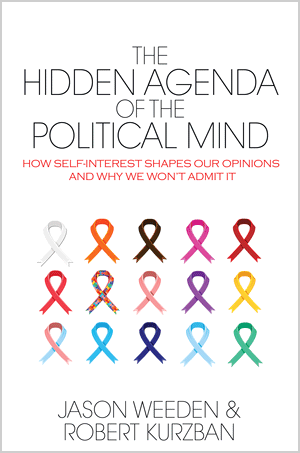
Two psychology researchers, Jason Weeden and Robert Kurzban, are pushing a simpler and less flattering hypothesis: that our opinions follow our self-interest. They argue, in their new book, The Hidden Agenda of the Political Mind: How Self-Interest Shapes Our Opinions and Why We Won’t Admit It, that the personality-based paradigm is circular. (Why do some people want to cut taxes? Because they’re the type of person who wants to cut taxes!) By contrast, their book relies on survey data, which show that the political views of various demographic groups line up neatly with their interests.
To say that our political views align either with narrow self interest, or with family interest, or with group interest, is to say not much at all.
Very few people will admit that their position on race-based affirmative action hinges on whether it helps or hurts them. But data from the 1994 General Social Survey show that blacks who thought they or a family member would lose a job or promotion to a white tended to favor affirmative action at a higher rate than blacks who felt secure in their jobs. Whites who thought they’d lose out from affirmative action opposed it more than whites who felt secure. Similarly, those most likely to need social insurance programs are most likely to support them.
Of course, no one admits that his political opinions emerge from naked self-interest, because no one wants to look selfish. Indeed, the authors argue that looking selfish is so distasteful that we won’t admit our selfishness even to ourselves. According to Weeden and Kurzban, we don’t have conscious access to the mind’s “hidden agenda.” In their most theoretical chapter, they compare the human mind to a corporation, and the conscious self to a slick corporate “spokesperson” capable only of parroting opportunistic talking points sent down by the “board of directors”—a collection of cognitive systems refined by evolution to propagate our genes. The spokesperson doesn’t even know what you really believe about the world. What you say you believe is public relations that the board, hidden in the dark wood-paneled executive suite of the Darwinian unconscious, has calculated to be in your genes’ interests.
All this implies that most of what we say, including what we say on surveys, is spin and Machiavellian confabulation, even when we intend the best. It is strange, then, to watch the authors treat survey responses as reliable evidence of the “hidden agenda” of self-interest, to which we are said to be oblivious. They argue that we’re full of bullshit—and then they believe everything we say. Even if survey respondents are unimpeachably sincere, it’s hard to connect those responses to the respondents’ real interests. To do that, you first need to identify what is in fact in this or that person’s or group’s interests. How do Weeden and Kurzban manage that task? Mostly they rely on common sense and the indulgence of the reader. When that won’t do, they resort to a more conjectural theoretical mode to account for the pattern in data. Consider one troubled example: Some people oppose abortion for what they say are religious reasons. But the authors consider this justification an illusion, and believe our political and moral opinions simply mask the pursuit of our interests. Here’s why, in the case of abortion. Among people who marry early, according to data from the U.S. National Survey of Family Growth, having had prior sexual partners sharply increases the odds of divorce. If members of this group are to raise children in stable, two-parent households, they need to marry spouses without much sexual history. Therefore, Weeden and Kurzban surmise, they should support policies that punish sexual promiscuity by (for example) opposing legal abortion—and survey data indicate that’s exactly what they tend to do. Ingenious! Then again, perhaps they just believe abortion is murder, exactly as they say.
The Hidden Agenda of the Political Mind: How Self-Interest Shapes Our Opinions and Why We Won’t Admit It. Jason Weeden & Robert Kurzban, Princeton University Press.
There are other problems with the book’s argument. Self-interest, narrowly construed, is an ugly thing, and in fact almost no psychologically healthy person really just pursues her own interest. Weeden and Kurzban recognize this, so they broaden self-interest, first to include family members, and then again to include “friends, allies, and social networks.” That equation is a bit of a bait-and-switch, and Weeden and Kurzban’s final concept of self-interest—they call it “inclusive interests”—tastes vaguely of stone soup. The expansiveness of inclusive interest threatens to render Weeden and Kurzban’s theory toothless, and possibly unfalsifiable: To say that our political views align either with narrow self interest, or with family interest, or with group interest, is to say not much at all.
The most puzzling aspect of Weeden and Kurzban’s argument is their failure to deal with one of the more durable conclusions of those who study self-interest in politics—which is that a truly self-interested, rational person would spend no time voting or cultivating political opinions at all. Because we live in large democracies, our individual votes and political opinions have approximately zero influence on determining which policies are actually implemented. So in that sense, it’s a waste of time to burn our hours discovering which policies would promote our interests if they were implemented. The cost of error in political opinion is minute compared to the cost of error in almost any other realm of our lives. If you’re wrong about whether there’s a car coming while you’re crossing the street, you die. If you’re wrong about whether we should raise the minimum wage, everything remains the same.
However, when it comes to espousing political opinions publicly, we do have one conspicuous self-interested motive: We’re better off when friends and co-workers approve of the things we say. Logically, it seems that Weeden and Kurzban ought to cut to the chase and argue that people espouse political opinions that advance their interests by making them look good, period. If we’re really self-interested, we should expect our political opinions to align with the going fashion among those who surround us, and that’s it. That argument would have made for a much shorter book—and, unfortunately, one more in your interest to read.
For more on the science of society, and to support our work, sign up for our free email newsletters and subscribe to our bimonthly magazine. Digital editions are available in the App Store (iPad) and on Google Play (Android) and Zinio (Android, iPad, PC/MAC, iPhone, and Win8).