Pacific Standard May-June 2013 Cover

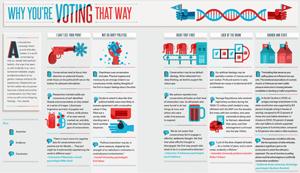
Why You’re Voting That Way

CLICK IMAGE FOR PDF
(Designed by Column Five)

As the election campaign heats up and attitudes harden, it’s worth remembering that our deeply held political beliefs—the ones that seem so self-evidently true—are a somewhat malleable, largely accidental product of our genetic makeup and early life experiences. Researchers are far from certain why one person becomes a liberal and another a conservative, but they have come up with some intriguing findings. For more Graphic Content, click here. ... Read More

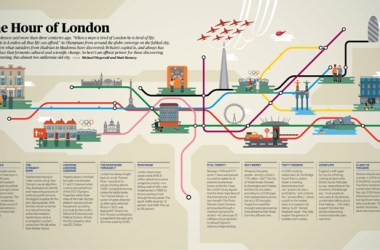
The Hour of London

PS July-August 2012 AbstractLondon

As the best athletes in the world descend on London for this summer's Olympic Games next week, they'll learn what outsiders from Hadrian to Madonna have discovered: Britain's capital is, and always has been, a place that ferments cultural and scientific change. Whether it's filling the role as the financial hub of Europe, or exporting the ideas of the internationally acclaimed academics from its 43 universities—the highest concentration of any city in Europe—London leads the way. In the current issue of Pacific Standard, we offer an off-beat primer on the disparate research coming ... Read More

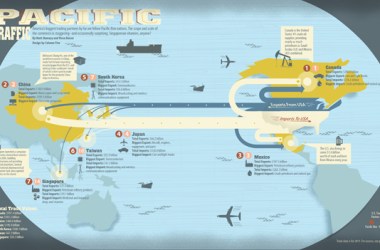
Pacific Rim Trade: a Great Blue Highway Out There

Preview of global trade graphic

While the triangle trade once dominated the American economy, these days the United States' biggest trading partners by far are fellow Pacific Rim nations. In the current issue of Pacific Standard the graphic below highlights the staggering scope and scale of goods that move between Ring of Fire nations and the U.S. Though NAFTA dominates the podium positions—thanks largely in part to Canada and Mexico being our first and third largest suppliers of crude oil, respectively—each year it gets harder to find products on American shelves without that ubiquitous label: "Made in ... Read More

Coworking Offices Abuzz With Independent Workers

The Beahive Scene

Working solo has its rewards. Still, we crave connections with other people. Which explains the rise of the coworking space, where “laptopreneurs” can drop in for a desk, a wireless connection, a productive atmosphere — perhaps even some collaboration. The idea took root around 2004, and a recent count tallied around 800 such spaces worldwide, 350 in the U.S. A seemingly urban phenomenon, coworking is now in small towns like Beacon, New York, population 15,500, 60 miles north of Manhattan. In 2009, Scott Tillitt, a Brooklyn transplant, opened Beahive there. About 20 people at any ... Read More

Do You Know Where Your Medicine Came From?

Foreign, Inspection-Free Drugs in Your Medicine Cabinet

Headaches. Insomnia. Anxiety. American medicine cabinets are packed with remedies for these common maladies. And up to 40 percent of them are manufactured overseas (along with 80 percent of active ingredients for pharmaceuticals). But a recent report by the U.S. Government Accountability Office estimated that in fiscal year 2009, the U.S. Food and Drug Administration visited just 11 percent of the 3,765 foreign factories it is responsible for inspecting — compared to 40 percent of domestic factories. In 2008, the GAO found that the FDA took two to five years to follow up with foreign plants ... Read More

Bridging the Budget Gap With Stolen Lunch Money

School Budget Cuts Graphic From AASA Survey

As the United States attempts to regain footing in its most severe financial crisis since the Great Depression, locally funded schools are left to shoulder the burden. Spending cuts are enacted to diminish the budget gap, while resources to core services, like education, slow to a trickle. The American Association of School Administrators published data from a recent survey detailing how K-12 school administrators across the country made cuts to their schools' programs. Click the image below to view the info graphic that appears in the September-October 2011 issue of Miller-McCune. It ... Read More

Battling World Hunger Through Innovative Technology

Battling World Hunger Graphic

Topics like farm industrialization and genetic modification seem to dominate discussion of technology's role in addressing world hunger. Beyond them, however, are new and exciting frontiers. From mobile apps to interactive games, technology is reshaping our understanding of and approach to world hunger. To see the illustration of these innovations that appeared in the July-August 2011 issue of Miller-McCune magazine, click the image below. Robotics Whereas the plant breeder's pursuit of an ideal seed has traditionally been time-consuming and resource-intensive, new technology is vastly ... Read More

Did the Stimulus Quench America’s Economic Thirst?

How Does Your Garden Grow - Stimulus Graphic

For the next financial crisis, what would be the best way to spend stimulus dollars? While some economists suggest a national fire sale and some pharmacists heaping helpings of hormones, an examination of how the current stimulus-dollar cascade has helped or hindered the recovery bears examination. That's what graphic artist Stanford Kay has done with buckets of data drawn from the Congressional Budget Office's scintillating bestseller from last September, "The Economic Outlook and Fiscal Policy Choices," plus the Bureau of Labor Statistics and Department of Commerce. While what strange ... Read More

Tracking Climate Change

Tracking Climate Change -- Carbon Footprint Graphic

As the international community tries to come to grips with climate change, the difficulties of reaching agreement on the regulation of carbon dioxide emissions worldwide are becoming ever more apparent. One sticking point involves the relative contribution of First and Third World countries to global warming. Developing nations have contended that industrialized countries caused climate change and ought to bear the brunt of CO2 regulation. The West points at exponential growth in China and India as a reason that regulation of carbon emissions must apply across the board. For atmospheric ... Read More

How Congress Uses Twitter

How Congress Uses Twitter

Like other Tweeters, U.S. senators and representatives who use the Twitter micro-messaging service choose whose feeds they wish to follow; these attention preferences are depicted below by arcs connecting followers to followees. Members of Congress and associated entities (the Hispanic Caucus and the Prayer Caucus, for example) are arrayed and colored on our diagram according to the partisan lean of the congressional people and entities they choose to follow — going from most Democratic in blue on the left, to most Republican-leaning in red on the right. The arcs are colored according to ... Read More