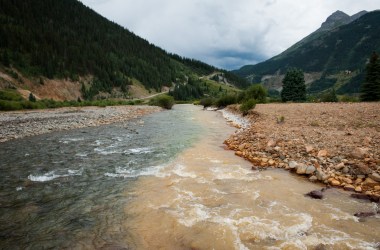

While traveling in Baja California, Kristian Beadle finds that water issues inland present a challenge and a threat to agriculture and the economy.
Location: Just inland of Cabo San Quintín, around the corner from a huge bay/wetland, lays an agricultural complex that serves the U.S. market.
Conditions: A generator whines and whirrs in the evening air — there is no grid electricity in this beach community. High-altitude clouds cover the night sky.
Discussion: The trans-peninsular highway cuts through innumerable small towns south of Ensenada; dusty farmlands blur in the glare of afternoon sunlight. I tried to put my sinus-induced headache aside and focus on the goal: to reach the mother load of Baja’s agricultural valleys, San Quintín, a place built for the noble purpose of selling America cheap food. How else could such a vast operation exist where water is brackish and the native soil resembles parchment?
We spent the night parked in a gringo ex-pat community slurping oysters that we bought from a roadside seafood peddler. Those wondrous mollusks, cultivated in aquaculture farms in the wetlands of Cabo San Quintín, were tempered with fresh lime and tapatio hot sauce, which did, in fact, improve my headache. Oyster farming and sportfishing are also important industries here.
During our morning walk, we discovered the beach was actually an express highway for fishermen towing their pangas. Sand dollars littered the dunes, like free money from another eon. Extinct volcanoes lay lumbering in the distance past the wetlands. People milled about and hopped on buses to work in the fields.
I visited a tomato farm that was being reconstructed after this winter’s storm damage, which washed away bridges and fields alike. The valley’s labor force of up to 25,000 people is 80 percent Mixteco, indigenous people from Oaxaca who left their eroded lands to find employment in San Quintín.
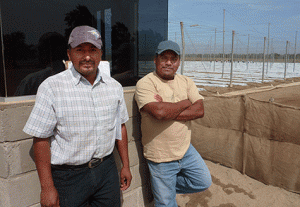
Sure enough, the guys I spoke to, Raul and Miguel, fit the description. “Hay trabajo aqui,” there is work here, they said, justifying the journey of many thousand miles from Oaxaca, except in the low season, Raul added, when people migrate to Sinaloa on the northern Mexico mainland to tend fields where “la agua es mejor,” the water is better.
I asked Raul what he meant by better water, remembering that my shower last night tasted a tad salty. He pointed out the two-story building next to us: a small desalination plant that converts the salty well water into irrigation water. This is a common and serious problem in flat coastal areas: saltwater intrusion in the freshwater aquifer.
Normally, the freshwater aquifer “floats” on top of a saltwater lens, as it is constantly re-supplied by rain and river runoff. However, saltwater is more buoyant (as you may have noticed — it is easier to float in an ocean than a lake) so for every foot of freshwater that is removed, the salt-water lens tends to rise several feet — and the well water starts coming up brackish with salt.
[Note: Salt-water intrusion is covered in more detail for curious readers in the accompanying box]
Running a desalination plant isn’t cheap — it is complex and uses a lot of electricity. If it weren’t for the hungry U.S. market across the border paying these extra costs, it wouldn’t be financially viable. Which begs the question: What would happen if the water became saltier due to over-drawing and/or sea-level rise? Would costs increase? What if energy became more expensive? I wondered if there could be a breaking point for farms to operate profitably — and if people’s jobs could one day be in jeopardy.
Unemployment around here was low, according to Raul. But if the industry took a tumble, and if he lost his job, I asked, where would he go?
“Maybe America — I have family there,” said Raul.
In the disturbing but highly informative book, Endangered Mexico: An Environment on the Edge, Joel Simon discusses how traditional farmlands in Mexico are no longer producing enough crops to support the peasant families living on them. Eroded and nutrient-depleted, it is ecological degradation, Simon claims, that has led to a massive migration to overcrowded cities in Mexico and illegal immigration to the United States.

For the time being, the equation appears favorable for San Quintín. The local paper had a big ad encouraging people to “protect the wetland, it supports our economy.” As we headed out of town, a sign for an RV park read, “fresh water showers, guaranteed!”
I wondered, guaranteed for how long?