Pacific Standard July-August 2013 Cover

About Matt Novak

Matt Novak writes about past visions of the future for BBC.com and Smithsonian.com.

How to Conjure a Ghost to Get a Murderer to Confess

ghost-prisoner

The proliferation of projection technology and electrical gadgets in the 1920s allowed people to conjure spirits. Well, spirits of a mechanical variety anyway. These ghoulish Jazz Age illusions entertained audiences and fooled ardent believers. But some thought that maybe this wave of high-tech ghosts could be put to use beyond the parlor tricks of supposed mystics. The November 1924 issue of Science and Invention magazine proposed using a slide projector and a little smoke to coax a confession out of alleged murderers—a "novel third degree method," as they put it. From the ... Read More

The Google Maps of 1917

communal-map

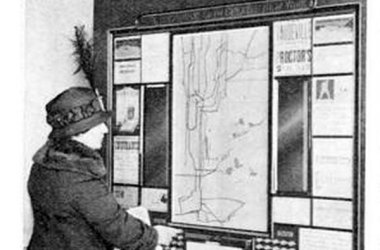
Our relationship with maps has evolved over the past hundred years. We don't have to unfold too-large sheets of paper, search out our destination, and trace back the route with a marker anymore. We can plug in an address or a point of interest, and a computer will tell us how to get there. But that might not be as new as it seems. This "electric directory"  from 1917 (pictured above) contains many of the elements any modern tourist in New York City might desire. Just push a button with the attached pen, and your route is illuminated. Local advertisers even had their own real estate on the ... Read More

Were There Robot Librarians in the 1950s?

fake-robot-librarian

In 1911, Popular Mechanics published some illustrations of things like Joan of Arc at a sewing table, a Civil War soldier being examined by an X-ray machine, and George Washington getting his photograph taken. Titled "Anachronisms of the Future," these pictures were meant to be humorous examples of things that people of the future—like those crazy kids of 2013—might believe had actually happened. On Monday a Twitter pal of mine sent me a link to "Librarian 2.0"—a photo that appears to show a book lending machine or library directory from the 1950s. But a few things about the photo ... Read More

Thinking Cap

thinking-cap

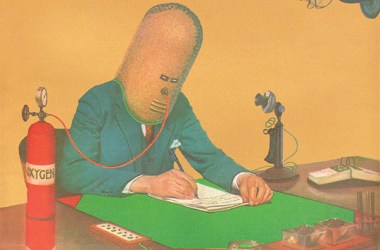
Decades before Twitter, Snapchat, and viral cat videos, inventor Hugo Gernsback bemoaned the difficulty of concentrating on desk work. Even back in the 1920s, noise from the street and the frequency with which “a telephone bell or a door bell rings somewhere ... is sufficient, in nearly all cases, to stop the flow of thoughts,” he wrote. Even more perniciously: “You are your own disturber practically 50 percent of the time,” always willing to be distracted by the wallpaper’s pattern or a buzzing fly, he warned. Gernsback’s solution, presented in the July 1925 edition of Science ... Read More

The First Audiobook: an LP for the Blind

lp-audiobook

From 1934 until 1948 long-playing records (LPs) were almost exclusively the domain of the visually impaired. But they weren't being used for music. Instead, they helped blind people listen to a brand new invention—the audiobook. In the early 1930s, the American Foundation for the Blind took on the project to get "talking books" into the hands of blind Americans, with a mixture of funding from public and private money. In the early 20th century, the major record companies had found success selling records that could only hold about five minutes of music, but they struggled during the ... Read More

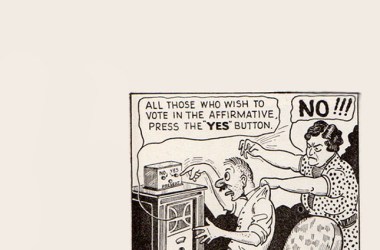
The ‘Like’ Button That Came Before Facebook

like-button

Talking back to our broadcast media seems to be an integral part of the early 21st century experience. Hulu is constantly asking me if a particular ad is relevant to my interests. Major news networks like CNN want me to give my opinion on breaking news stories to them via Twitter. Even here at Pacific Standard we encourage you to leave comments on stories. In the parlance of advertisers, this two-way street of media communication is called "engagement." It might seem like something that's just started popping into conversations recently, but the idea is as old as broadcasting itself. In ... Read More

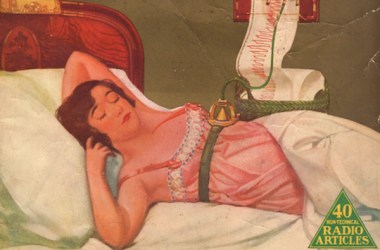
The Dream Recorder (of 1926)

dream-recorder

Last week, new research was published that showed the first objective recording of the contents from a dream. Using an MRI machine and images from the Internet, researchers in Kyoto, Japan, devised a way to decode with some accuracy what people were visualizing while they slept. But scientists and science fiction folk alike have been targeting the elusive dream for capture since at least the 1920s. The cover of the September 1926 issue of Science and Invention magazine included concept art of the "dream recorder" machine. The device wasn't invented by sci-fi publishing pioneer Hugo ... Read More

Nikola Tesla and the Myth of the Lone Inventor

edison-tesla_fe

This post is based on a talk I gave at South by Southwest and a version of it first appeared at BBC Future. Who invented the Internet? To answer that seemingly simple question you basically have two options: you can go on for hours explaining the hundreds of people and institutions that contributed crucial advancements to the way that the Internet operates, or you can just say Vint Cerf. Or Leonard Kleinrock. Or Tim Berners-Lee. People have been fighting for decades over who invented the Net. Some will tell you that Vint Cerf’s work on its underlying protocols—TCP/IP—was its ... Read More

Will California Build an Earthquake Warning System?

A Santa Monica apartment building destroyed by the Northridge earthquake in 1994 (PHOTO: SPIRIT OF AMERICA/SHUTTERSTOCK)

On March 27, 1964, a 9.2 megathrust earthquake rocked Alaska. It was the most powerful earthquake to ever hit the United States and 143 people lost their lives. The earthquake lasted almost four dreadful minutes as office buildings in Anchorage folded in on themselves and homes tumbled down cliffs. No one saw it coming. Just as no one could predict Monday's 6.2 earthquake in Guatemala (which thankfully didn't cause any serious damage). There's no surefire way to predict when an earthquake will strike (and some experts feel that as a practical matter the push for prediction should be ... Read More

Adding a Horse to the Horseless Carriage of Yore

Horse attachment as depicted in the 1937 Popular Science film "Horse-Friendly Auto Attachment"

Last month we looked at an invention from 1904 which could be attached to the front of your horseless carriage in order not to spook that of the horsed variety. Today we have a short film of that pseudo-horse in action (or at least a re-enactment). From the 1930s until the 1950s Popular Science produced short newsreel-type films which would play before Paramount Pictures movies. Much like the magazine, the short films usually would take a look at some of the weirdest new inventions around at the time. But proving that we're far from the first generation to revel in nostalgia, the ... Read More