Pacific Standard May-June 2013 Cover

About Lisa Margonelli

Lisa Margonelli, contributing editor, writes about energy, the environment, science, and policy for such publications as Forbes, Slate, Politico, The Atlantic, The Nation, and The New York Times, and many others. She is a research fellow at the New America Foundation. Her book Oil On the Brain: Petroleum’s Long, Strange Trip to Your Tank won the Northern California Book Award for nonfiction and was named one of the 25 notable books of 2007 by the American Library Association. She has received two excellence in journalism awards from the Society of Professional Journalists. She works in Oakland, California.

The Environmental Defense Fund Is Pissing Off Fellow Environmentalists

fracking-red

The battle over hydraulic fracking of oil and natural gas has pitted land owners against each other. It has also creating divides between neighboring states such as Pennsylvania, Ohio, and New York. And now, after the Environmental Defense Fund joined a coalition of non-profits and oil companies called the Center for Sustainable Shale Development, fracking is also splitting the environmental community. The Center for Shale Development advocates that oil and gas companies voluntarily adopt 15 performance standards. These cover wastewater disposal, fracking fluids, air pollution standards ... Read More

Nikola Tesla Would Not Approve of Your Online Viewing Habits

nikola-tesla-corner

Since March 11, a 2 minute, 4 second rap smackdown pitting eccentric genius Nikola Tesla against more mercantile electric genius Thomas Edison has gotten 13,952,858 people to watch it (as of the time of this writing). Not bad for a feud that reached its peak in 1897. Tesla, though, hated to waste time—even for sleep—so he probably would not have approved of the 474,397 hours the world's collective eyeballs have spent watching this video alone. Nor of the electrical use—5,692.7 kilowatt hours of electricity used by YouTube's servers, or approximately enough to power an American household ... Read More

How the Trailer Park Could Save Us All

trailer-park-end-of-world-lead

Residents call life at Pismo Dunes Senior Park "Pismodise." Park manager Louise Payne calls it "a holding tank for the great beyond." Louise has short hair and blunt bleached bangs that give her the air of a preteen skateboarder, but at 72 she's often found rolling by the park's 333 trailers in her electric golf cart, alternating between her roles as mother hen and whip-cracker. California is a notoriously youthful culture, but eventually the perpetually young get very old. If they're lucky enough to live in Pismodise, which is on the Central Coast, they can exit its palm-lined entrance, cross ... Read More

Guide to a Sizzling Planet

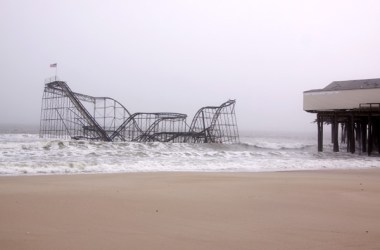
The Casino Pier Star Jet roller coaster submerged in the sea on January 13, 2013 in Seaside Heights, NJ. (PHOTO: GLYNNIS JONES/SHUTTERSTOCK)

Overheated: The Human Cost of Climate Change By Andrew T. Guzman (Oxford University Press, 249 pages) A Newer World: Politics, Money, Technology, and What’s Really Being Done to Solve the Climate Crisis By William F. Hewitt (University of New Hampshire Press, 304 pages) I'M WRITING THIS a few blocks from Brooklyn’s Red Hook neighborhood, where business owners are still cleaning up after the catastrophic floods of Hurricane Sandy in October. Walking down Van Brunt Street a few weekends ago, I stepped over mildewed Sheetrock and around piles of corroded electrical equipment: ... Read More

The Energy Debate We Aren’t Having

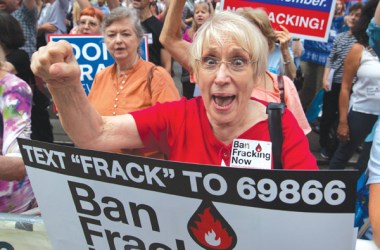
Anti-fracking activists hold a rally outside a Democratic Party policy summit in New York in August 2012 to express their opposition to fracking to Governor Andrew Cuomo. (PHOTO: ALLAN TANNENBAUM/NEWSCOM)

BY RIGHTS, the events of 2012 should not have happened: for the seventh straight year Americans reduced their oil consumption, while for the first year since 1859, the U.S. increased oil production by more than 800,000 barrels a day. For 40 years Americans have fretted about our increasing thirst for oil, declining production, and consequent reliance on oil imports. Suddenly all that has been reversed. Inspired by high fuel prices for oil and gas, and new applications of fracking, (see “The Deluge” ) a drilling boom spans the country. Last year was really a dual victory: for ... Read More

Why We Should Drop the ‘Mad Max’ Metaphors

A rare still from 'Mad Max: Fury Road,' with Tom Hardy in the role of Max Rockatansky

Here’s a drinking game: Sit down with some friends and talk about modern life and fossil fuels—supply, demand, embargoes, carbon, cars, batteries, whatever—and see how long it takes for someone to mention Mad Max. Ever since 1979, when an Australian ER doctor named George Miller and his friend James McCausland released a bootstrapped film about a bunch of gnarly drifters driving around looking for gasoline after the apocalypse, Mad Max has become the cultural reference point for fossil fuel depletion and the dystopia that ensues when “people don’t believe in heroes anymore.” ... Read More

The Formula

(ILLUSTRATION: MARK MCGINNIS)

On the evening of August 18, 2011, viewers of The Daily Show were treated to a droll but distressing lesson in statistics. “The United States is not a Third World country by any measure,” Jon Stewart told his audience, “except, perhaps, income inequality.” To Stewart’s left, a ranked list of countries flashed on the screen, topped by Sweden. Then, in a blur, the list scrolled down to its middle-bottom reaches. “We rank worse than the Ivory Coast, worse than Cameroon: 64th!” After a few moments trash-talking the nations just below us on the list (“In your face, Uruguay, ... Read More

Mouse-Infest Destiny

(ILLUSTRATION: GRAHAM SMITH)

UNTIL A FEW WEEKS AGO I didn’t have the slightest interest in mouse urine. But after some study I’ve concluded that it is covertly running and ruining the world, strangling small children, and driving the profits of Big Pharma. I came to know mouse urine, the molecules of which are known as MUPs (Major Urinary Proteins), and specifically as Mus m 1, because the molecules were stubbornly clinging to the studs of a cabin that I recently bought. Though I didn’t yet know the molecular names or weights of my MUPs, I knew they were there. Mice had burrowed through the cabin’s fiberglass ... Read More

Why Can’t Obama Articulate His Energy Strategy?

energysources

When President Obama says his energy strategy is “all of the above,” I cringe. The statement is hardly inaccurate: pushing every kind of energy from nuclear to natural gas and oil to solar, wind, energy efficiency, and grid upgrades is exactly what he’s done during his term. What I dislike is that the president is missing an opportunity to tie all the stuff he’s doing into a grander strategy to decrease carbon emissions, give Americans control over their energy spending, and sustain long-term economic growth. “All of the above,” is using a lame-ish crutch where Obama could be ... Read More

Could the Smart Grid Finally Do Some Good for Consumers?

shutterstock_49070605-l

Americans shop for viciously for bargains, whether it’s getting plane tickets from discount web sites or driving across town to save 30 cents on a tank of gas. But when it comes to electricity, we’ve been simply writing checks for the bills we receive at the end of the month. Few of us know how much we pay for a kilowatt hour, or how many kilowatt hours we use—or what a kilowatt hour actually is. Since the 1920s, Americans have paid flat regulated prices per hour for electricity. But de-regulated wholesale electricity prices now gyrate extravagantly from nearly zero at night to as ... Read More